Priority Commuter Bike
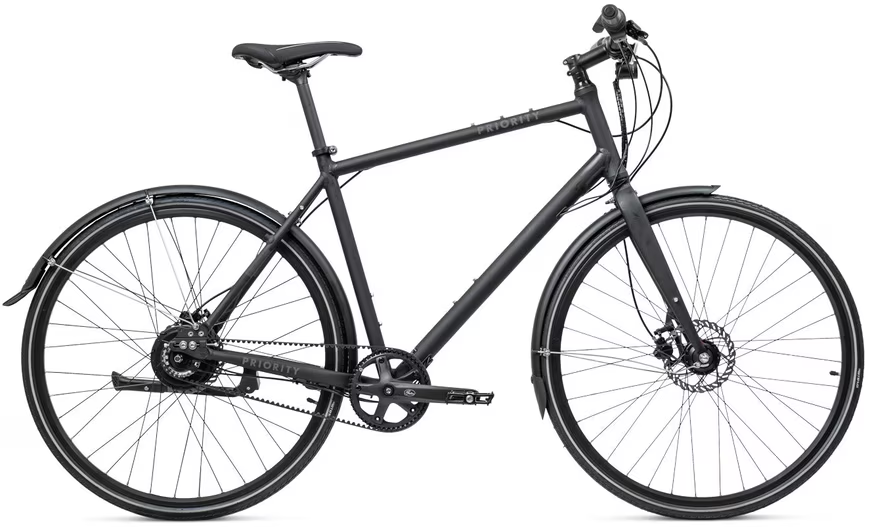
I realized that I've written here about my Santa Cruz MTB and my Orbea Road Bike, but that I never wrote about my commuter bike because I purchased it during the period when I stopped writing to this blog. Today I'll fix that omission!
In late summer 2020 I purchased a Priority Continuum Onyx to replace my Frankencommuter bike. My old commuter was a hodgepodge of parts: a Nashbar road bike frame (called the "Framé" and no longer available for purchase), along with various used bike parts I acquired over the years; mostly from when I upgraded parts on my bikes. It was fine for what it was but after using it for about ten years it was wearing out and I was ready for something nicer. There were aspects of the bike that could never be fixed. In particular, the inability to fit fenders to the frame led me to decide something else was needed.

After doing research I decided I wanted a belt drive bicycle. I was interested in belt drive bikes because all the positives (listed here) seem perfect for a commuter and the negatives unimportant, or at least less important than the positives. They are low-maintenance, long-lasting, and clean. There are negatives (listed here; more later), but even some of the negatives have positives. For example, it's impossible to shift gears on a belt drive using a standard derailleur. To have more than one gear requires an internal gearing system, often placed in the rear wheel hub. This makes the bike more complicated, heavier, and less efficient. However, because the gearing is internal, it's sealed away from rain and dirt and requires less maintenance, exactly what I want from a commuter bike.
Priority bicycles sells only belt drive models, and I settled on the Continuum Onyx. It had basically everything I wanted:
- Belt drive
- Continuously variable transmission (CVT) internal rear hub (more on this later)
- Fenders
- Built-in lights using a front-hub dynamo
- Hydraulic disc brakes
- Reflectors everywhere, including the tire sidewalls
- Upright seating with flat bars
- Forgiving 32C tires
- "Acoustic" a.k.a. non-electric. At home I have to carry my bikes up and down a flight of stairs and I didn't want a bike that weighed 50-60 pounds
About the only thing they omitted, and probably should include on a city commuter bike, is a bell. Like reflectors, bells are legally required in many jurisdictions (but never enforced, really). I have added a bell and it's useful.

The are definitely negatives to a belt-driven bicycle. The bike is fairly heavy, especially in the back (although I'm probably spoiled by my other quite light bikes). It's also clearly less efficient than a standard chain-driven bicycle. I am not as fast as I think I would be on a similar non-belt driven bicycle at a given level of effort. Many parts of the bike would be hard to fix on the go. However I only ride it in town, and worst case I'll leave it locked up somewhere and use my bus pass to get where I'm going and return for it later. Doing any kind of maintenance that requires removing the rear wheel is a decent hassle.
The CVT rear hub has its plusses and minuses. On the positive side, in contrast to a traditional derailleur, it doesn't require any fine adjustment. It uses a single grip shifter(*), meaning that the bike can reasonably be operated with one hand that can both shift and brake (e.g. you're carrying a pie in your other hand). Coming from typical bikes with set gear ratios the CVT is at first very weird, but being able to change the ratio by just a smidge is useful. The minuses come down to the same issues mentioned above: weight, efficiency, and difficulty of working with the rear wheel. In my opinion the plusses outweigh the minuses.
After four and half years of ownership, it has indeed been a very low-maintenance bicycle. Other than pumping up the tires once or twice a month:
- I recently replaced the brake pads (front and back) and bled the hydraulic brakes. I've done this before on my mountain bike, and once I figured out how to shimmy the bleed block into the brakes, it was actually easier than the Santa Cruz
- I can't remember the last flat tire, and I think I've had less than 5 flats overall
- The new (see below) kickstand spring mechanism gets gummed up with road grime and about twice a year needs to be cleaned out
I do have some minor to medium complaints about the bike that mostly consist of the items Priority saved a few bucks on:
- The factory-spec kickstand was flimsy and I had to replace it when it broke. I replaced it with a two leg kickstand (holy moley, how can someone write hundreds of words about a kickstand?) that is far stronger and better than the original one. The one I purchased is especially nice and I spent more than I could have, but the one Priority supplied was not very well made
- I'm on the third bottom bracket. For both previous the bearings holding the spindle went bad and the bottom bracket developed a very annoying click. It is likely that a higher quality bottom bracket would solve this issue
- The connector that links the dynamo hub to the wire that runs to the lights is cheap and needlessly difficult to reattach after removing the front wheel. It's probable that this connector is matched to the hub, and the dynamo hub is not manufactured by Priority, but it's annoying
- The provided pedals were plastic which I replaced with some metal ones I already had. Looking at flat pedals online, the cheapest metal pedals are only a few bucks more than the least expensive plastic ones. Surely this price difference is smaller when buying in bulk
- I have replaced the saddle. Saddles are a very personal choice and it's impossible for one saddle to work for everyone. No fault to Priority here
Overall I have been and am very satisfied with the bike. It has delivered on almost all of the promises of a belt-driven bicycle. If Priority & the dynamo manufacturer made the choice to spend a few more bucks (and really, just a few bucks!) in a few places, my complaints would be basically zero.
(*) I generally dislike grip shifters, but considering how the CVT works, I think this is an exception, and it's a good solution.
New Road Bike
In late 2013 I built a road bike (not pictured) from individual parts. I built it using a 2012 Fuji Altamira frame and fork, 11 speed Campagnolo Chorus, and Mavic Wheels. It was a fun project to source all the parts and put it together. I have enjoyed riding this bike in the 11 years since I built it.
The bike has not been without issues. A few years ago the rear derailleur broke. What broke is not important to mention here, except that in the end my father in law was able to weld a fix, and I remain appreciative of that. The bigger problem is that very shortly after I built up my bike, Campagnolo made a small change to their 11 speed products that broke backwards compatibility. A replacement to my 11 speed rear derailleur was basically impossible to find, hence the need to fix the derailleur with welding. Since then, I've known that if anything broke again, I'd either have to buy a whole new component group, or a whole new bike. In a sense, I've been on borrowed time.
In the intervening decade since I built the bike, there have been a few major changes to road bikes:
- Rim brakes have been replaced with disc brakes. I think that disc brakes are wonderful on mountain bikes, I have them on my MTB. For road bikes I think they are less crucial. The stopping power of rim brakes is more than enough for road bikes. However, disc brakes on road bikes is the direction the market has gone, probably for better (on balance) than worse.
- Electronic shifting replaced the cable actuated shifting with batteries, wires (or radio signals), and servos. Instead of levers, the shifters on the handlebars are simply buttons and moving the derailleurs is handled by a computer. I have been manually shifting for over 35 years without too many problems, but I am also not a luddite and the precision and speed of electronics are hard to beat.
- Internal cable routing runs cables inside as much of the bike structure as possible. There are aerodynamic advantages to this, and it also prevents dirt from accumulating on the cables. It also makes installing and servicing the cables much, much harder. Personally, I like the look of a bike with internal cabling.
- Tire clearance has inflated (ha!) dramatically. My Fuji can only handle 25C tires, while many modern road bikes can handle 32C or higher. Partially enabled by disc brakes (because rim brakes struggle to reach around large tires), larger tires allow for lower tire pressures that make riding more comfortable.
- Tubless tires remove the tubes inside tires. This is similar to tires on cars, except that bike tires typically have liquid sealant inside. On a mountain bike the advantages of tubeless are many, not least of which they eliminate the possibility of pinch flats. I have tubeless tires on my mountain bike and I think that they are well worth the hassle. On road bikes the advantages are less clear. The tire sealant only works at lower pressures, around 40 PSI. This means that a tubeless tire inflated to 90 PSI that gets a small leak will simply hiss out sealant (spraying it everywhere) until around 40 PSI, at which point the sealant can do its job. But then the tire is at 40 PSI, and you're squishing along on a really soft tire that's better than a fully flat tire, but not by much.
In summary, there have been a number of changes to road bikes in the last decade, most of which my Fuji either couldn't take advantage of, or wasn't worth doing. I decided it was time to get a new bike that had some or all of the new technologies.
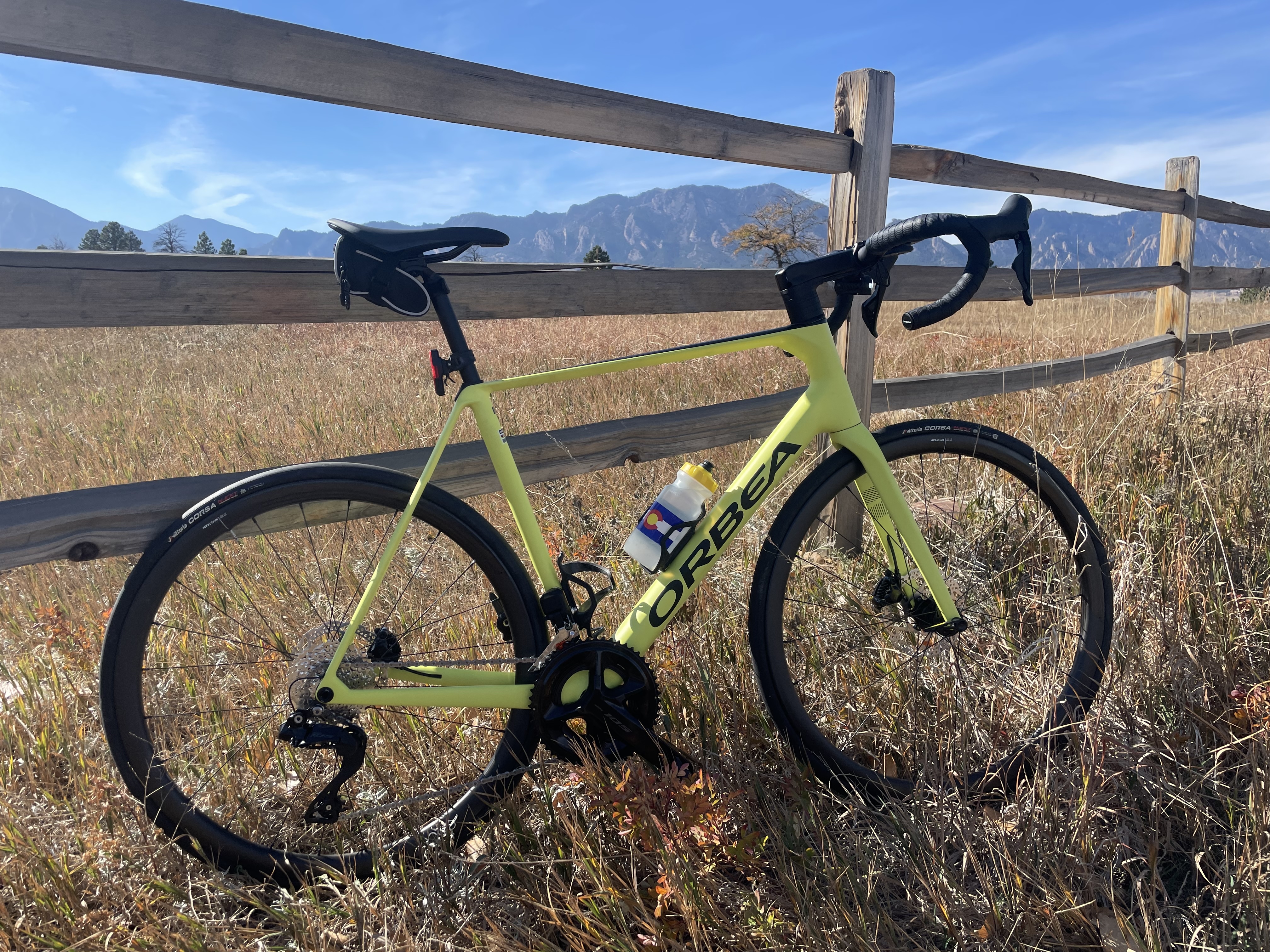
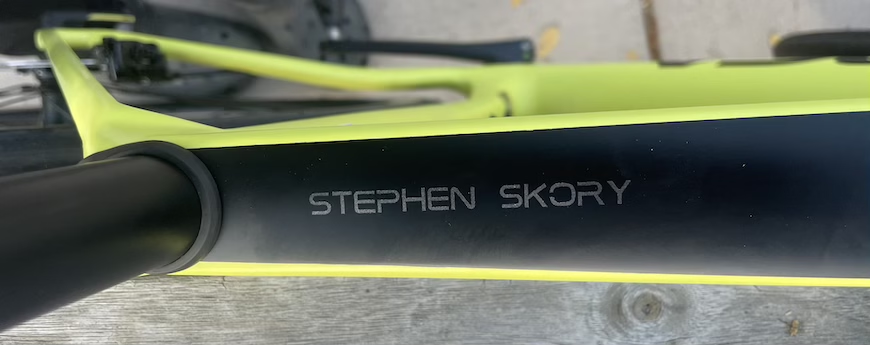
After thinking about it for many (many) months, looking at lots of options (there is a spreadsheet), in early August 2024 I ordered a custom painted Orbea Orca road bike from a local shop. I have always liked Orbea bikes, and Orbea custom painted bikes cost the same as off-the-shelf models. Many other manufacturers charge extra for custom painting. The three month wait is fine if you already have a bike. I've always wanted a yellow and black bike, and that's what I got. I even have my name on the bike!
Of all the technologies mentioned above, the only one my bike doesn't have is tubeless tires. It is "tubeless capable," but I don't think I will do that. It has 12 speed Shimano Di2 electronic shifting with hydraulic disc brakes. The tires are 32C, quite a bit bigger than what I have on my Fuji.
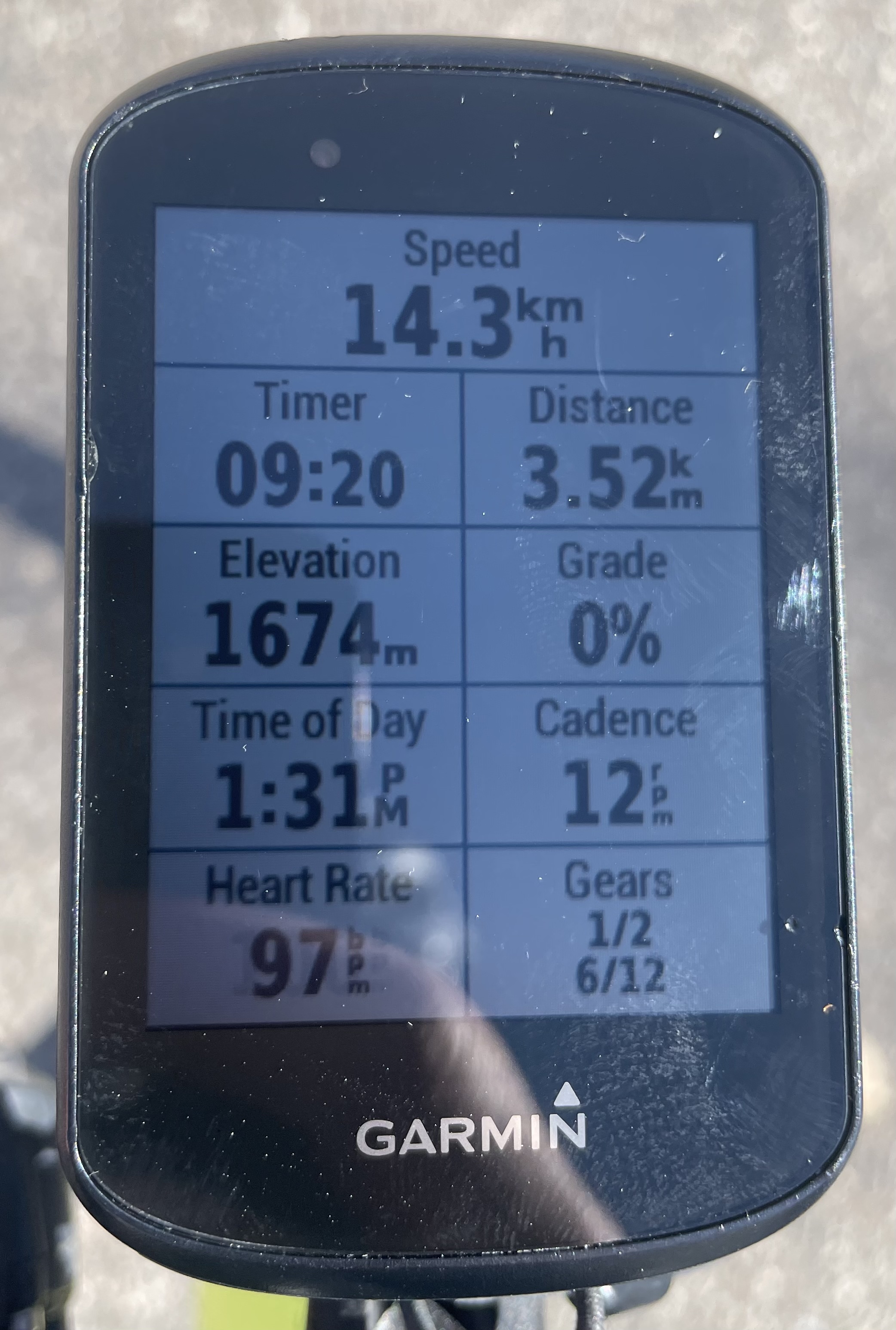
The Shimano Di2 system is semi-wireless. Each shifter has a coin battery and communicates wirelessly with the derailleurs, and the derailleurs share a rechargeable battery that's stored in the seat tube. As shown below, the shifters can connect to my Garmin 530 and it can show what gear I'm in and the state of the batteries. Supposedly for average usage the derailleur battery lasts a few months, but having this view will be useful.
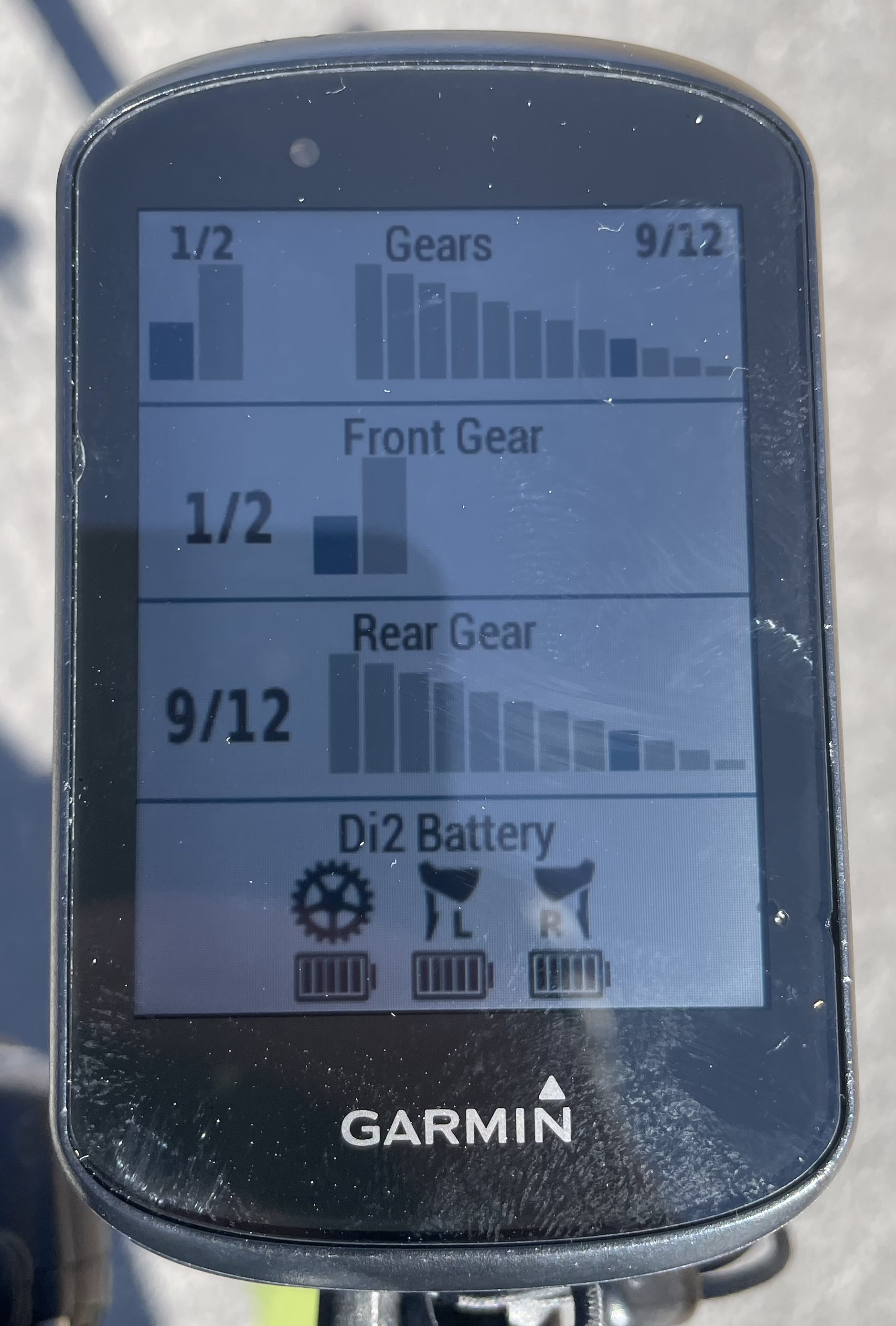
As I write this, I have only gone on one short ride to acquaint myself with the bike and adjust things. I think I will probably change the saddle and I may also change the seat post. I think the bike looks wonderful, it rides great, and I'm excited to ride it more. Of course, it's heading into winter here, and opportunities to ride will be less than in the summer. But that's okay, it will allow me to make sure it's set up the way I want in time for the spring and summer.
Purging The Old Cycling Clothes

Above is a collection of worn-out cycling shorts and jerseys that I am going to get rid of. All the shorts are worn out and uncomfortable. The jerseys have holes or are being held together with safety pins. Basically, I don't see myself wearing any of this ever again.
Judging by how long since I last purged my old cycling clothes, I will do this all over again in about 9 years.
My New MTB
Earlier this year I bought a 2018 Santa Cruz Tallboy C. This is my first full squish mountain bike, and it is awesome. The thing just floats over rocks and is much more forgiving than my old hard tail. It has 29" wheels, a 12 speed cogset, disc brakes, and a dropper post, all of which make the bike completely different from what I'm used to. Comparing times on Strava, I am faster on descents and any reasonably bumpy sections with this bike, which isn't exactly the point of getting a bike like this, but it is nice. There are trails I had stopped riding with my old hard tail because they were not fun that this bike makes fun. And that's the point.


Old Cycling Material
In the process of clearing out some old files, I came across these historical documents of the two collegiate cycling national championships I've helped organize. I have scanned them and uploaded them for your enjoyment.
- 2007 Track Nationals Rider Manual – hosted by UCSD. The pink color is on the original and an artifact of a printing error. PDF File
- 2003 Road Nationals Rider Manual – hosted by UC Berkeley. PDF File.
- 2003 Road Nationals Logo – this awesome logo was made by my good friend Kristin Prentice. It still looks sharp!

Homemade Bike Rack Mount
Below are some photos of the homemade parts I made for the truck that my old bike rack can interface with. I used pieces of shelf rail that hold the Yakima feet, and attach the whole stack to the rails on the side of the bed. This arrangement allows me to dis/mount the rack in a minute or so, which is how things have worked on previous vehicles with the rack, and I'm happy that it can work the same here. It's not the prettiest thing, and I suppose I could paint them black so they blend in better. Anyway, they were about $250 cheaper than the "official" Yakima system, so a little unsophistication is acceptable.


Leader Track Bike

Yesterday I got the replacement frame for my Broken Fuji track frame. I got an aluminum LD 735TR 61cm track frame and carbon fork for a very reasonable price, especially considering how short notice it was. I have several friends who are riding Leader frames and they are happy with them. Happily, this new bike has considerably less red than the Fuji.
If you look at the full size image (by clicking on the image above), you'll see that I've placed a piece of an old tube around the top tube using two green zip ties. This is there to protect the top tube from the handlebars, which tend to whack the top tube. Regular bikes don't need this as brake and shifter cables help dampen the handlebar swinging motion.
When I put my Pro-Lite carbon disc rear and aero front wheels (which should arrive soon!) on this black frame, it will look awesome! And that's what counts.
Broken Fuji

Almost a year ago, during my return trip from Indianapolis, my 2005 Fuji Track Pro was dented due to the TSA improperly re-packing my bike box after inspecting it. I managed to parlay this into an almost $1000 check from the TSA after documenting their liability quite thoroughly.
The bike wasn't actually fatally damaged. It still rode true and there weren't any cracks, just a dent. Aluminum tubes are strong enough to use as long as they aren't creased with sharp edges (this is what I have been told). For the last five months I've been riding my Fuji with a dent in the downtube with no problems -- until now. Now, I'm afraid, the bike has made it's last lap of a velodrome. Yesterday I found that the dent has turned into a crack that you can see. The crack starts in the dent and works around the bottom of the tube to the other side.
In my Fuji's lifetime it has seen four velodromes: San Diego, Hellyer in San Jose, Northbrook in Chicago and Major Taylor in Indianapolis. My cyclometer has 2850 km on it, which works out to 1770 mi. Most of my time has been in San Diego, which is a 333 meter track. Major Taylor is also 333m, while Hellyer and and Northbrook are slightly longer. I'll simply use a 333 meter lap. That odometer distance gives 6800 laps. I'm sure the actual number is quite different than that, but you get the idea. 6800 laps is a bunch of going fast, and turning left. And not forgetting to pedal.
Goodbye good friend!
Now I need to find a new frame, soon. Hopefully the new one won't have any red on it, my one dislike of the Fuji. When that's all sorted out I'll post a picture of my new single speed steed.
Bike RV


Here are some photos of a "Bike RV" that my father took in Northern California a few days ago. Notice in the middle photograph that there are at least three derailleurs! Here's what my father wrote:
Found parked alongside US101 on the way to Eureka. He lives in it, has pedalled it all around the US, has been doing this for years. The vehicle weighs 600 lbs or so. The panel above the seat is just a sun/rain shade, not a solar panel. The mechanical details were nicely done but I think the aerodynamics could be improved. On the other hand it's geared low and likely never goes very fast. Small bike wheel in front, fat rubber-tired go-kart wheel in back. I didn't look to see what kind of brakes. All in all it's pretty amazing that the guy could live in and pedal the thing around. I talked to him a bit, and as you might guess he seemed mildly unhinged.
My question is how does he get the thing started? Getting 600 pounds moving is no small task. And going uphill? He appears to have at least three levels of down-gearing. How does he go fast enough to not fall over? Maybe he has to spin the pedals at 120 RPM to even go anywhere. I also don't think the sun/rain shade could be that effective. To me, if I wanted to protect myself against the elements, I would get some kind of acryllic shell to go over the rider's position. It would also be much more aero.
Maybe I'm just more sane that this guy, but if I were to do this sort of thing, I'd get a bike trailer to load all my stuff behind a normal bike. Then I could ride a normal unhindered bike if I wished, leaving the trailer at the campsite. I'd have to sleep in a tent, but that's okay.
Intel MacBook, Parallels & Garmin GPS
Just a few days ago, I replaced my four year old white 500 Mhz G3 iBook with a shiny widescreen white 1.83 Ghz Intel Core Duo MacBook (the black one seemed altogether silly to spend extra money on). The laptop is a very nice machine. My home machine is a 20" iMac G5 with a widescreen, and I've gotten used to the extra real estate, so I like the fact that the MacBook has one too. Really, the main reason I bought it is because my iBook had decayed to the point that it was only good for websurfing. I wanted a machine I could use at school, and the iBook just couldn't cut it (I definitely tried to make the iBook work!).

Since Apple is switching to Intel chips, the world of Windows is now available using either Boot Camp or Parallels. I have a copy of Windows 2000, and since I believe that Boot Camp only works with Windows XP, I am not going to try that out. Also, Boot Camp makes your machine dual-boot, which means only one OS at a time and no interaction between the two. Parallels is the more attractive option, it allows you to run Windows along with Mac OS X. The Windows world lives inside of an application that runs on Mac OS X. Choosing to interact with Windows is no more difficult that switching applications. Also, Parallels works with basically any Intel-compatible operating system, so I could use my Win2000 install disk.
After much trial and tribulation (mainly related to the fact that my Win2000 is an upgrade version, not full install) I got Win2000 installed using Parallels on my MacBook. After installing the myriad of security updates, I installed the softwares for my Garmin Forerunner 301. You see, Garmin (right now) only makes software for their gadgets for Windows. They've promised to make a Mac OS X verison of the software I use by Spring 2006 (they have two and a half weeks). Obviously, waiting around for that to be relased will just waste my time, so I was hoping that I could use this whole setup to run the Windows software on my MacBook to talk to my GPS. However, sadly, it doesn't work. It's clear it almost works, since Win2000 notices when I plug in the GPS, but the Garmin stuff can't quite talk to the GPS. The situation seems exactly the same as when I tried using Virtual PC on my G5 over a year ago.
All in all, I like the laptop, I like Parallels, and I'm displeased with Garmin. I'm using a beta 30-day activation key with Parallels, and I'm unsure if I'll buy the full version ($40 for pre-ordering). I really try to stay away from Windows applications. Right now the only app I do want to run is the Garmin stuff, and it doesn't look like that's going to work.
Funky Bike Mount
The Garmin 301 Forerunner, which I've mentioned before on this site comes with a velcro wrist band. Which is great for running but when I cycle I prefer to have nothing on my wrist. Whatever I have on my wrist tends to slide down and rest against the top of my hand (because my wrist is bent upwards holding the handlebars). The skin then gets pinched whenever I go over a bump -- which is often.
But my anal-retentiveness doesn't stop there! Simply putting the unit on the handlebars wouldn't suffice. I prefer to have nothing at all on the handlebars because I shift my grip over the entire width of the bars. I wanted the unit front and center, where it belongs, anyway. I knew I had to be creative!
I have faced this problem before mounting a Polar HR unit in front of the handle bars. That time I built an aluminum mount that was wedged between the stem and faceplate. That has since broken (it wasn't the best design anyway). I wanted something similar.
So here it is, a funky bike mount:

I used a Polar HR mount with a piece of PVC pipe stuck inside of it. I then used four zip ties (two in tandem at a time) to attach the mount over and under the handlebars and around the stem. I also used some pieces of rubber to make the whole arrangement thicker so the watch band would be tight. Luckily for me there was a small hole between the polar mount and the front of the stem where I could fit a band:

The 301 uses the normal wristwatch style attachment with the pins, so I just bought a cheap drug store plastic band a cut down one side so it could fit through the hole pictured above. You can see that the band has been slimmed:

The mount isn't the most steady -- the unit does shake. But I think it's pretty sturdy and I'm confident that my gadget won't go flying.
Garmin Forerunner 301 & Mac OS X
I recently bought a Garmin 301 Forerunner, a nifty wrist-sized GPS unit with a heart rate monitor. The premise is pretty cool -- I can see my heart rate next to the elevation profile of my route, along with an interactive map showing exactly where I went (once I upload the data to a computer, of course). I've been without any kind heart rate or cyclometer for almost 6 months since my old Polar S510 decided to croak. Apparently my sweat is so caustic that I rusted one of the buttons stuck and I lost some functionality. Then the battery died. A perfect excuse to upgrade, right?
Even before I bought the 301, I knew that it would have some problems. Specifically, Garmin is one of those block-headed companies that refuses to acknowledge Mac owners as more powerful than their market share suggests. We spend more money and buy more gadgets than Windozes people; see the iPod. I purchased the 301 anyway; I have an unconditional satisfaction guarantee with REI in case I give up on this project.
My hope was to to be able to use the 301 with a Windows Virtualization Software. This is one of the first GPSes to use USB, rather than the antiquated serial that manufacturers still cling to. So I figured it may just work with VPC. However, no luck. It seems like it almost works -- when I plug the GPS in Win XP recognizes the device and loads the Garmin USB GPS driver. The GPS shows up correctly in the device profile. I can install the Garmin software perfectly too. However, the Garmin software refuses to connect to the GPS. Very frustrating.
I verifed how it should work by using a regular PC, and I had no problems. Both the Garmin and MotionBased software works.
MotionBased is also annoying. The upload program is only Windows. The main interface is entirely web-based, but has poor Mac support. It makes Safari crash and I have had middling success using IE or Firefox. They have a free account option with limited functionality, and for $100/year the full suite of analyses. It's unlikely I'll be shelling out any money to them until they improve Mac support.
Right now I'm leaning to keeping the 301. I have enough access to Windoze machines to be able to use it. But I'll keep it begrudingly. Garmin is a big enough company to put some time into Mac OS X.