What Earning a PhD Does to Physical Activity
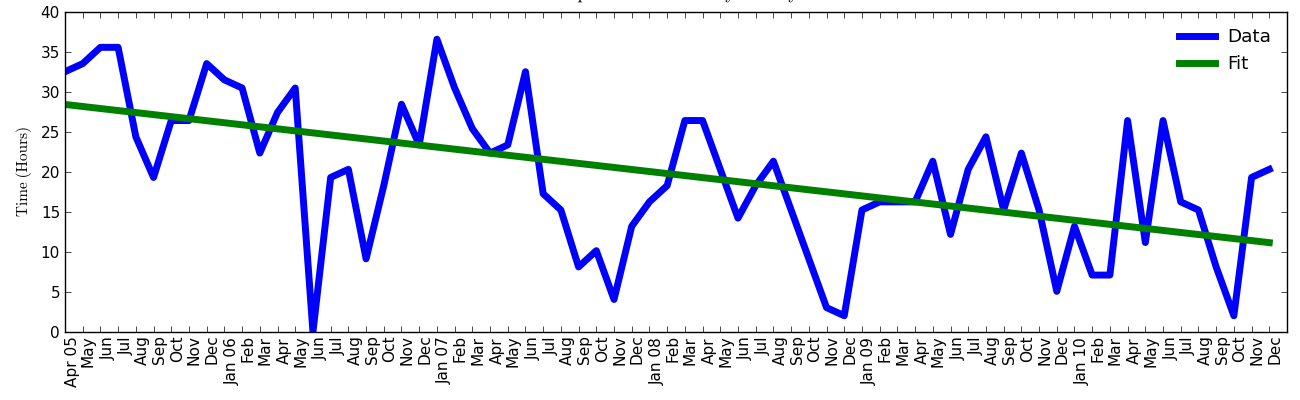
Above is a plot showing how many hours I have logged on my Garmin GPS devices since I got my first one in April 2005. This is mostly cycling, but also walking, running and some hiking. However, this is not a true measure of my physical activity over this period because it is missing data. Up to late 2007, I was active on the velodrome, and I didn't bother using my GPS there. In the last year, I've tried to walk to school more often, and for the most part I haven't used my Garmin on those walks. But it does capture the majority of my physical activity, which is road and mountain biking, where I always use a GPS.
In green I've over-plotted a linear fit to the data. I have chosen a linear fit as it shows the overall trend in the clearest way possible. For some reason, June 2006 shows zero hours, which I believe to be wrong. I can't believe I did nothing at all during any summer month in 2006. Therefore, for purposes of the fit, I have given that month the average hours of the four bracketing months.
Even knowing that lots of data is missing from both the front- and back-ends of the figure, it is still clear what the overall trend was. Down - down significantly from nearly 30 hours a month five years ago to just above 10. There of course is a great variability from month to month, but the fit shows clearly the overall trend of what trying to finish graduate school does to physical activity.
I find the lack of patterns interesting. Some years, I really struggled to stay active during the late fall, which makes a certain amount of sense when weather and schoolwork is factored in. However, other years it apparently didn't affect me at all. The bounce in hours since October 2010 makes sense because that's when I graduated, but the two months in 2010 with 25+ hours is confusing. I can't remember how I achieved that!
Nerd time: I made the figure in Python using matplotlib and numpy. Excel is for suckers!
Busy Times in Colorado
It has been nearly a month a half since my last post about leaving San Diego, and we've finally made it to Boulder! Ok, actually it didn't take that long. It took us two days, with a stop overnight in Saint George, Utah. The long gap in posting is due to how busy I've been here in Boulder, which has been nearly entirely due to getting my thesis done, but also to a good deal of work getting the new apartment put together. Those things deserve their own posts, which may or may not happen.
What I would like to post here are some pictures I took on my bike ride yesterday. I am 99.7% done with the draft of my thesis which I'm sending to my advisors this weekend, so I figured I could take some time to ride my bike recreationally. This is a novelty for me recently. Come wintertime, I'm definitely going to miss the weather in San Diego, but right now, cycling here definitely beats San Diego. It takes less than ten minutes to get out of town onto roads like this:
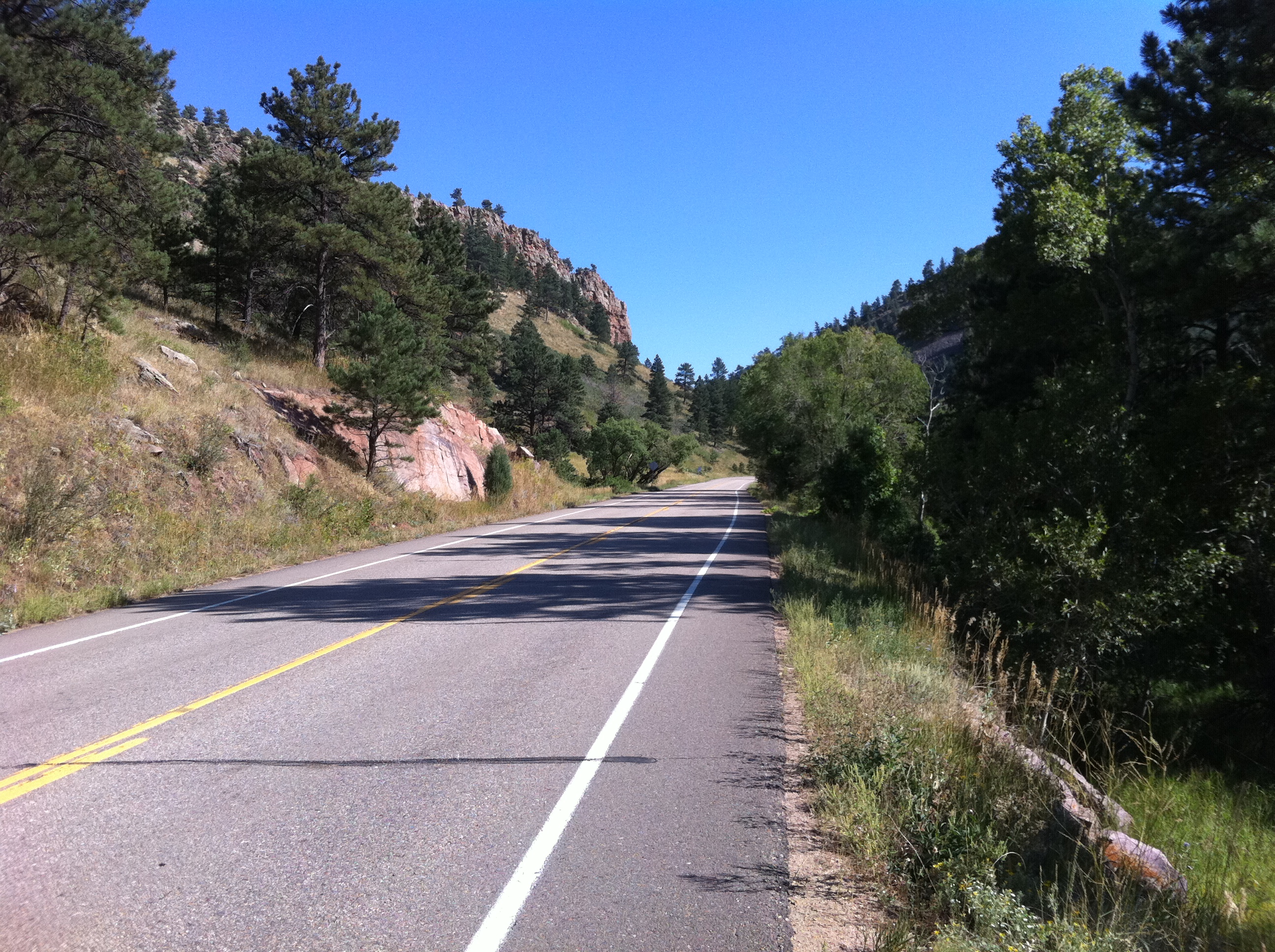
or this:
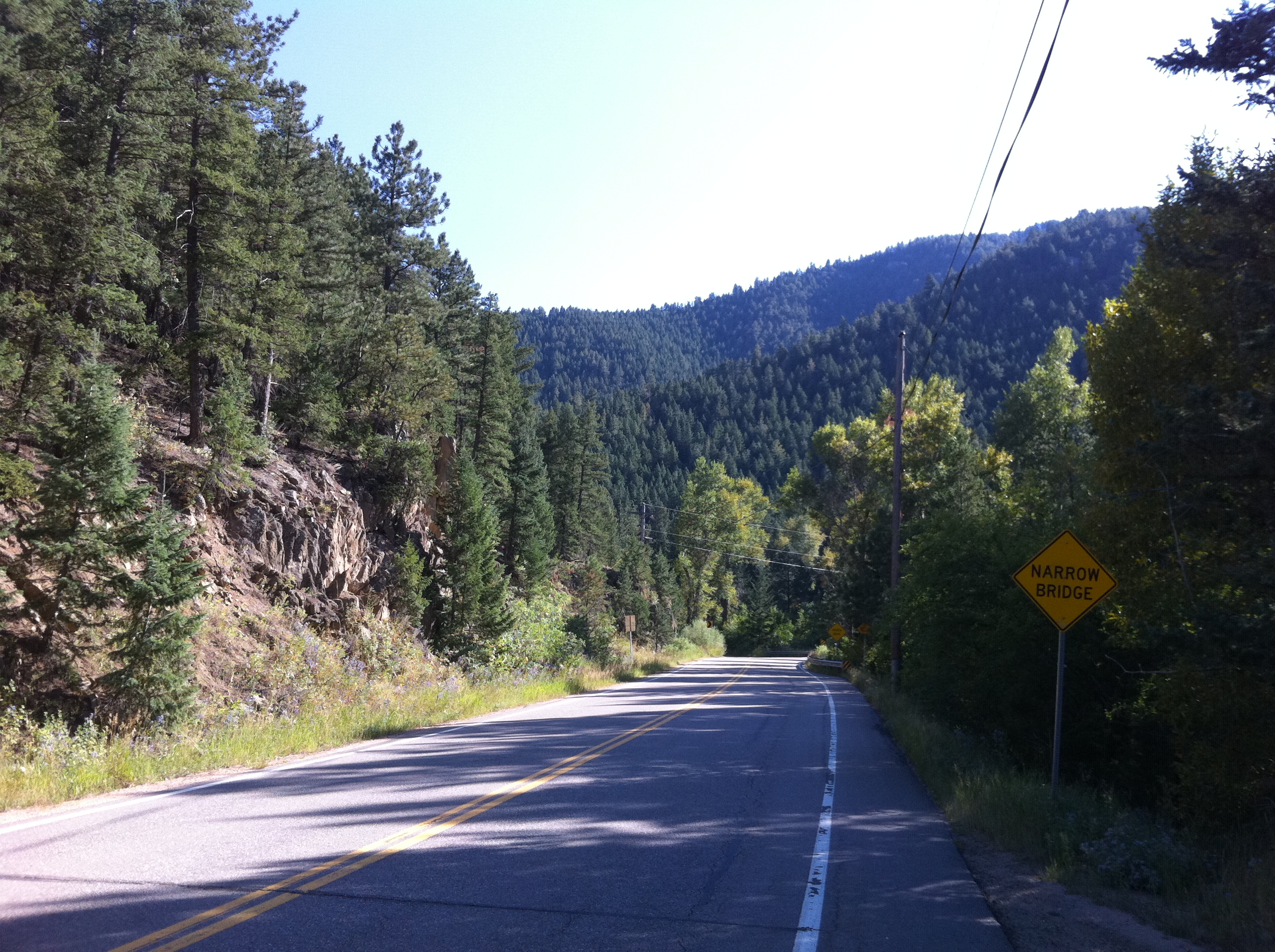
or this where it feels like I can see all the way to Kansas over the plains:
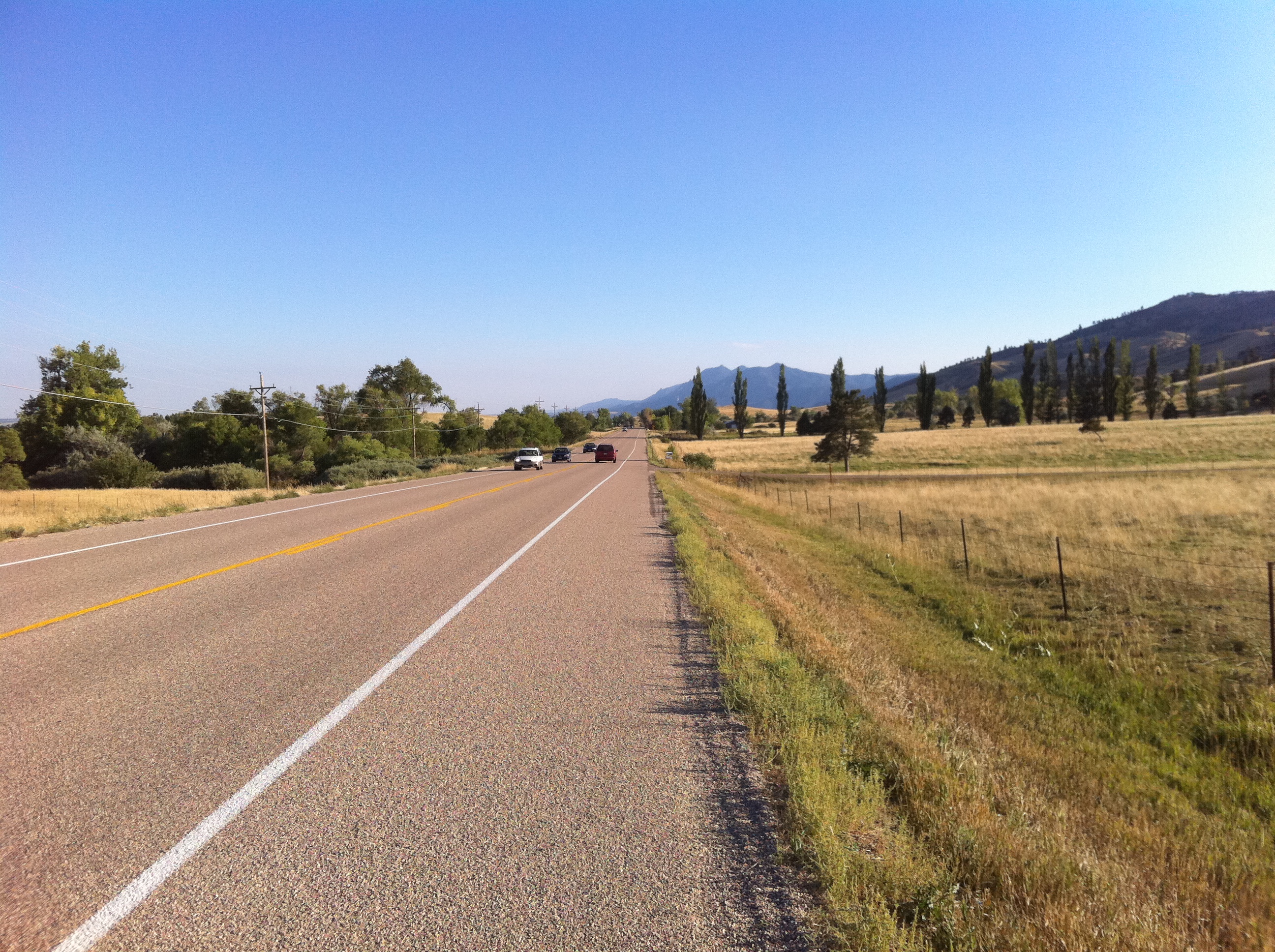
I just wanted to share. Hopefully, now that the bulk of the thesis is done, I can enjoy this area a bit before winter hits!
Ethics Course
I guess the UC system has been working it's way down the ladder of the compensation scandal hierarchy. I thought they had forgotten about that sweetheart deal I gave to absolutely no one. I finally got my invitation today to learn how to stop myself from doing absolutely nothing again. I've decided to include you with me as I clean up my act. Off we go!
Page 1: What? No pig latin? Utbay tsiay hatway mIay ostmay omfortablecay ithway!


Page 2: It's our President, Robert Dynes, with a video message. From the video it's clear he's not used to the talking head bit. His eyes are a good 15 degrees away from the camera the whole time. My favorite part is when he says "I liked it" when referring to taking the ethics course himself. If he really did enjoy it, he's disturbed.
Page 3-5: Blah blah blah. Introductory text, a short outline of the course.
Page 6: This reminds me of Dilbert comics I've seen before. The last one below has me thinking -- when was the last time a graduate student really felt like their dignity was being respected? I suppose in the end we only have ourselves to blame since we got ourselves into this mess.
We are committed to the following principles:
Integrity. We will conduct ourselves with integrity in our dealings with and on behalf of the University.
Excellence. We will conscientiously strive for excellence in our work.
Accountability. We will be accountable as individuals and as members of this community for our ethical conduct and for compliance with applicable laws and University policies and directives.
Respect. We will respect the rights and dignity of others.
Page 7-8: I'm given the "Standards of Ethical Conduct." In summary, except for the financial reporting bits, it's pretty much the same thing you might get in your high school welcome book. Respect others, respect yourself, do right for yourself, snitch on others. That sort of thing.
Page 9: Oooh. We're finally getting relevant to me now. We're going to follow the ethical decisions of "Edna" the Business Manager of a large department. This describes my position and responsibilities as a physics graduate student.
Page 10-13: Uh ohs, Thuvan (a name I've never heard before) is taking perks from hotels. Thuvan schedules large conferences and chooses hotels which will receive this business. Thuvan is spending all day hanging out at hotels getting free food and services. It looks like Edna has to talk to her about following ethics rules.

Page 14-17: A professor just got a big grant, and wants to hire the department chair's wife for a position, but without doing a proper job search. Tim wants to play along so there's no trouble from the professor, but Edna knows better. It looks like Edna has to sit down with another employee. Notice the slick graphics to help me visualize the situation.
Page 18-22: A professor has found a desirable, young and grant-rich researcher at another institution, and would like to hire her. But in order to do this, her salary would be higher than university standards. Oh no! Do we follow the rules or ";make a secret promise to raise the salary in a year?" We follow the rules, of course.
Page 23-45: I'm going to be nice to you and speed you over the rest of Edna's ethics situations. She really has got a bunch of lousy employees. The only things I learned that apply to me are: Don't steal lab equipment (no one will notice a super computer missing, will they?) and don't gossip to the media when your lab-mate gets arrested (I'll just do it anonymously, guys).
Page 46-48: Just use common sense, dammit! Well, it didn't say dammit, but it should have.
Page 49-51: Here they're just insulting me. They give an example of a campus gardner who used what he learned from an online ethics course in a few sticky situations. They're attempting to show that even low-level employees have ethics choices to make. But even here, this gardner has more power over facilities and purchasing decisions than I do. I want them to give the example of an employee like me that applied what he learned. The problem is, I have power over nothing. No one is going to put me in a sticky situation because I have nothing to offer in return.
Page 52: Regent Parsky gives me a video message thanking me for taking the course. No, thank you Regent Parsky.
Page 53: An offer to provide feeback and a certificate of completion!!! Whew. Now I feel validated. This is going up in my office so everyone knows my ethics are unreproachable.

Congratulations to you if you read this far.
A Bit of Shiny
Below is a little animation that I made yesterday that shows what I have been doing lately. The green dots correspond to the positions of dark matter particles, while the little yellow squares are the locations of dark matter haloes that I'm interested in. The white lines are the edges of the simulation volume, and you can see the axes triad in the bottom-left corner. To give you an idea of the scale of what's depicted here, each edge of the cube is 50 Mpc, or 163 million light years. Our entire galaxy is only about 20 kpc or 65,000 light years across.
In the first part of the movie, the cube is rotated about its center. Next, while looking along the z-axis, the volume of the cube plotted is reduced until only 1/10th of the cube is shown. Then, this 1/10th thickness is scanned through the entire cube, and then the volume plotted is replenished back to full.
The things to notice are how the dark matter form areas of high density, which are connected by filaments. Between these are areas of relatively few particles, which are called voids. This is how our universe really looks, with huge collections of galaxies clustered together, separated by huge expanses of nearly empty space. I should point out that there are many more galaxy haloes in this box besides the yellow boxes.
What I was looking for was one of those yellow boxes which is fairly isolated from areas of high density dark matter. I picked one, and now I am doing this same simulation again, but with higher resolution boxes centered on the area of interest. The simulations I'm doing right now are fairly cheap (in computer time currency). I want to be sure that when I run big, time-intensive simulations in the future that I've picked a good area to focus my attention on.
I did this visualization with Visit, a stereo, 4D visualization tool out of the Livermore National Lab. The "stereo" means that it can create two images of the same data that are slightly offset, which create a 3D effect if viewed correctly. The fourth dimension is for time, as it can handle time-ordered data sets. I then used Visit's Python scripting features to output 800 individual PNGs, which I then stitched together (exactly like my time lapse movies) to make this movie.
Galaxy Family Tree
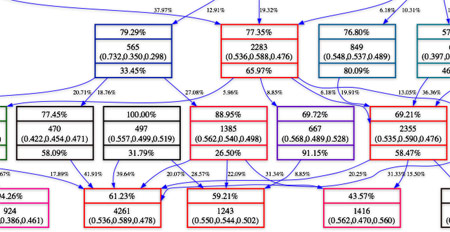
Above is a part of what I've been working on lately. It's a small part of the galaxy family tree that I've derived from a large simulation. In the simulation there are several ingredients that are thrown in the "box." Relevant to this are the dark matter particles, which coalesce into consituents of galaxies. The dark matter particles have unique id numbers. Using a some code I didn't write, I process the simulation data and make a list of galaxies along with the particles in each galaxy. Then, using some code I did write, I track particles and galaxies over a number of time steps, which builds a relational mapping. Then, I use Graphviz to make a nice tree, as you see above.
Inside each box are either three or four data values. The top grid shows what percentage of the particles in that group came from no group, the middle grid shows both the number of dark matter particles that are in the group and the position of the group, while the bottom grid shows the percentage of the particles that go to no group. The simulation takes place inside of a 3D box with length 1 on a side and periodic boundaries (which means the distance between 0.9 and 0.1 is 0.2, not 0.8). The colors of the box correspond to its ranking in size, red is the largest, green the smallest. The numbers next to the arrows are what percentage of the parent group goes to the child group.
The goal of this is to get an idea of how the galaxies form over the course of the simulation. Of course the simulation tries to mirror reality, so this family tree may be worth something.
Expedite my PhD
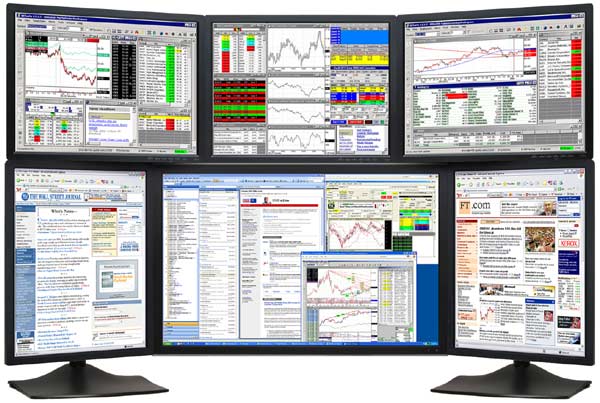
Do you want to help me get my PhD faster? If so, go on over to this website and buy me one Zenview six screen multidisplay. I'd also like you to buy me a computer capable of running all the monitors.
It's only your money. We're talking about my education here!