Public Works and Public Costs
During the school year, I am able to almost never drive a car during the school/work week. I can get where I'm going, with what I'm going there with (e.g. a kid, a laptop, some light groceries, etc), by bicycle. Right now it's summer, and because of where and when various summer camps drop-off and pickups are, I'm driving every day. I would prefer to not do this, but it's only for ten weeks or so, and I can manage it.
What I'm here to complain about, however, is something else. Because I'm driving more, I'm impacted by summer road construction projects, and I find them frustrating. For those of you who don't commute by bicycle regularly, I'll explain. When you commute by bicycle, you know exactly how long it will take to go from A to B. This might not be true in Amsterdam or Copenhagen, but here there's never enough bicycle traffic to impact travel times. But with driving, I have to budget in extra time for construction zones that may or may not have a lane restriction in place. I find this annoying and inconvenient.
Sitting in these backups and seeing only a handful of workers actually doing anything at any one time has given me time to develop an opinion. In short, all publicly-funded works should include the cost to the public in terms of delays and inconvenience when comparing competitive bids. These costs won't actually be paid, but they will be used to compare the true public cost of each project. Let me explain with an example.
Let's say a road needs repaving, and there are two bids:
- Company A will do it for $100,000 and take 30 days
- Company B will do it for $150,000 and take 15 days
Next, using traffic data and other factors, it's found that each day of construction would cost $4,000 from the public in delays, fuel burned in extra traffic, and so on. Bringing in these costs, the true public cost of each bid is:
- Company A $100,000 + 30 * $4,000 = $220,000
- Company B $150,000 + 15 * $4,000 = $210,000
Using this policy, Company B would win the contract despite coming in with a higher bid.
I haven't invented anything here, these are called external costs, and our society would work much better if they were more effectively and consistently applied to taxpayer-funded projects. With penalties for missed deadlines, it would encourage competence and efficiency. Instead of sitting in traffic seeing only five people working at any one time for six weeks (ask me how I know this), you'd see dozens working for only a few days or a week. The public perception of government projects would improve and society would be better for it.
Sadly, because it would be good for society, this will never happen.
My House Obsession Update
In January I posted about a house for sale in Boulder that I was slightly obsessed with. You can click through that link for the full story, but the short version is the sellers were asking for too much money for over a year. I had a bet with myself that the final sale price would be no more than $2.3 million. I can happily report that I was 100% correct: the house sold two days ago for $2,225,000, over a million dollars below the initial asking price.

As glad I am to be correct, I hope the developer/seller didn't lose money. I want new housing to be built in Boulder, and if developers lose money, that won't happen. At the same time, I don't want sellers (including private parties) being overly greedy, and I do have a little bit of schadenfreude when unreasonable sellers are shown that the housing market can have some logical sense.
There's very similar new build, unsold house in Boulder that was initially listed just after the one above. It hasn't sold likely because it has yet to fall below 70% of its initial asking price. It is also being sold by a developer. I probably won't post about it when it sells, but the fact that it hasn't sold yet, when the one above has, should tell the developer that they need to lower the price more (and be less greedy).
Sadly, there's always truly greedy (and/or delusional) developers, like this one. They have dropped the price less than $150,000 over a year and a half on an initial asking price of $4.7 million. By my math, they need to drop by at least ten times that before it will sell. I hope they enjoy paying property taxes, insurance, utilities, and the construction loan on an empty house for another 15 years!
My House Obsession
As of this writing there is a house for sale here in Boulder that I am slightly obsessed with. It is located at 2595 Glenwood Dr (Redfin link) in North Boulder. We live in South Boulder, but this house is only a few blocks away from where we lived when we first moved to Boulder. It's also on one of the primary routes I use to go North/South through Boulder on my bike, and I've had a chance to keep an eye on the location for years. I am not obsessed about it because I like the house in particular. It's in a fairly typical modern style with multiple exterior materials and way too much white paint inside. It's nice enough, and I assume well built, but it's nothing unique nor special. I'm obsessed because I find the history of the property fascinating. I find it fascinating because the people involved have been delusional for years about the worth of this location. In another universe, if the sellers had been less delusional, we might have thought about building a house on it. I'm also obsessed because I have a small bet with myself of the price at which the house will eventually be sold, and I want to be correct.

There is some property history in that Redfin link above, but I'm not sure it's complete for the story I want to tell. The earliest record is December, 2022, but I think my obsession started even before that. Below is my best recollection of the order of events:
- The lot the house sits on used to be part of a larger lot for the house next door, immediately to the West. Some time before December, 2022, the owners of that property put the East half of their property on the market. At the time that house had an extension that impinged on the proposed East lot. The property listing indicated that this extension would be demolished, but the upshot is they were trying to sell a piece of property that wasn't ready to be sold and developed. This is the first indication that the sellers were delusional. Delusion count = 1.
- If my memory is correct, they first asked for $750,000. At the time, even during the height of COVID house pricing mania, the most expensive houses in that neighborhood were in the $1 to $1.2 million range. This means that to build a house that was in line with the neighborhood, a builder would have less than $500,000 to spend. This was not realistic, meaning that any house built would have to be the most expensive in the neighborhood by a large amount. Delusion count = 2.
- Needless to say, the lot didn't sell. I think during this period the extension was demolished and the original house remodeled.
- After some time, the lot listing was updated, but this time it included architectural designs and a $150,000 price increase to $900,000. I think this brings us to December, 2022. To summarize, the lot didn't sell at $750,000, and they thought that including plans for the house they wanted next to them justified increasing the price by $150,000. Maybe they thought that following through on the extension demolition justified part of the price increase? Delusion count = 3.
- The property was eventually sold for $500,000 in June, 2024, a year and a half later. Redfin doesn't show this sale, but it's available on the Boulder County Property Assessor Site. The current owner is "GLENWOOD SPEC LLC," which is almost certainly an LLC created for the sole purpose of building and selling a home on this lot. There's probably nothing shady nor unusual about this, but it is interesting.
- Apparently the build went fast enough that it was put on the market in February, 2025, for $3,250,000. This is roughly three times the price of any other home in the neighborhood. It is quite a bit bigger than nearby houses, and newer (of course), but it is on a small corner lot next to a semi-busy road which are demerits that other homes do not have. Delusion count = 4.
- It was at this point I made the bet with myself that the house would sell for no more than 70% of this price, or around $2.3 million. By the way, I cannot be sure, but I think that the real house is nothing like the design that was being sold for $150,000.
- In the (almost) year since, they have slowly dropped the price. They dropped it by $300,000 after three months of not selling1, but since then by increasingly smaller amounts, with the most recent drop a few days ago of just $30,000, bringing the latest asking price to $2,570,000. It looks like they got a bite in August, 2025, but it didn't go through. It's almost certain that in the last year the owners have been paying construction loans, insurance, and property taxes that I'm sure are at least $10,000 a month2. This means that each month that goes by that the house remains unsold, they are effectively lowering the their profit by $10,000 by being stubborn. I'm going to count this slow pace of price reductions and stubbornness as Delusion count = 5.
- This brings us today, and if my bet is correct, still nearly another $300,000 to drop until it's sold. And I could be wrong about my bet by being too conservative. The actual sale price could be lower than that!
Would I buy this house? Certainly not for $2.3 million. There is a price I would pay, but it's a price the seller would never accept. The lot is really small, and I don't think I would want to live next to the semi-busy road. I do like the neighborhood, it's a few blocks to the nearest grocery store and a short bike ride to downtown. We would like a bigger house, but I don't think this is for us.
Finally, here are two regressions predicting when the house might sell. First, if we assume a linear pace of price reductions with respect to time, the $2.3 million price I predict it will sell for will be reached at about 420 days after the initial listing. That's around three months from now.

The sellers probably don't want to sell the house at a loss, meaning that
there's probably a floor below which they really don't want to sell.
In that case, the ask price might be following a 1/x-like curve.
Using that to fit, I predict it their price floor is $2.26 million and it
will take around 3615 days to reach $2.3 million, which is about 9 years from now.
If this fit is correct (it probably isn't and and I hope it isn't for their sake),
they would spend over $1 million on taxes, insurance, and the construction loan
before the house sells, which would likely be a massive loss.
Which is why this fit is almost certainly baloney!

You can be sure I'll keep an eye on this property. Will the seller find new ways to be delusional? I'm excited to find out! I'll follow up even if I end up being wrong and the house is sold for more than $2.3 million.
Solar Water Monitoring Page
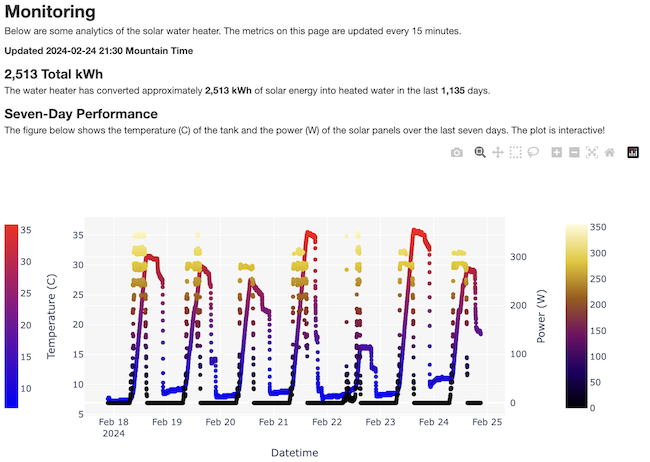
Today I just published a page that monitors my solar water heater. Every fifteen minutes the Raspberry Pi that controls the system pushes updated metrics to this website and triggers a refresh of the plots on the page. There's a diagram and description of how the whole system works. Go ahead and check it out!
Blue Mountain Dr
Taken today, 45 minutes away from my workplace by bicycle.

New Chicken Coop
A few days ago we transitioned the chickens from their old coop to a new one we've been building for several months. This project involved more than just the coop, which is why it took several months. We replaced a crumbling fence with a gate, and built another gate to fully-enclose one of our side yards to serve as a chicken run. The new coop is very sturdy, has french doors for easy access, and should be very comfortable for the chickens.
There is still some work to be done, including figuring out what kind of siding we want to put on it, and also an automatic chicken door.


Homemade Bike Rack Mount
Below are some photos of the homemade parts I made for the truck that my old bike rack can interface with. I used pieces of shelf rail that hold the Yakima feet, and attach the whole stack to the rails on the side of the bed. This arrangement allows me to dis/mount the rack in a minute or so, which is how things have worked on previous vehicles with the rack, and I'm happy that it can work the same here. It's not the prettiest thing, and I suppose I could paint them black so they blend in better. Anyway, they were about $250 cheaper than the "official" Yakima system, so a little unsophistication is acceptable.


Solar Powered Shed Lights
Here are some photos of the solar powered LED lights for our sheds. My father very generously put together the lights, battery, solar panel, and wiring, and shipped it out to us. Over the last couple days I installed them in the sheds.


North Mesa Apartments Lawn

Everyone likes a nice grass lawn. They're soft, aesthetically neutral, and you can recreate on them better than plain dirt or asphalt. They require lots of maintenance and water, but there are definitely situations when they're a wonderful thing, like in a large public park. You can play touch football on it, or croquet, or play with your dogs. You can also have a picnic on a lawn under a shade tree.
They are not a wonderful thing in the apartment complex where I live. San Diego is in the desert, even though we are next to the ocean. Nearly all of our water is imported from the Colorado river or points north. Water resources are finite and San Diego cannot continue to grow without heeding this fact. I find the lawn where I live to be completely ridiculous, and the photo above shows many aspects of why I find it so excessive.
- It has been raining almost once a week for the last few weeks, but not enough to make the kind of mud seen here. Furthermore, I see mud like this all year, including the summer when it never rains. These lawns are either over-watered, poorly drained, or on really bad soil.
- Just beyond the muddy track you can see some dead brown spots. There are spots like this everywhere. Too muddy here, dead just over there. Something is wrong.
- There are concrete paths between all the buildings. The maintenance workers drive around in little carts, usually on the paths. Even so, they feel their time is precious enough to cut off the paths and ruin the lawn like this. Why even have a lawn here when it's going to get ruined?
- In the corner of the photo you can see some entirely reasonable shrubberies that cover the minority of the ground in the complex. They require much less water and care then the lawn. I see them being tended only a few times per year, perhaps as often as once a month.
- Once a week I see a horde of men (I guess 4) on lawn mowers tear nosily past my apartment. Another day a week someone comes by with an edger, grinding the cutter between the path and the lawn. The next day the leaf-blower comes to blow away leaves and grass cuttings. By adding these up, my guess is that the lawn costs about six days wages per week. That's a more than a whole employee, and I get to pay for this.
- Because so many of the lawns are either muddy, or brown, I rarely see people recreating on them. It also has to do with the fact we're all graduate students and have other things to do (like write complaints like this). Since this isn't a city park, technically the surrounding community can't use it (there are "no dogs" signs at the entrances), so the number of potential lawn clients is small.
If things were the way they should be, there would be considerably less lawn coverage. There would be some lawns that were kept in good condition, well drained and large enough to recreate on. Places seen above would be turned into something less water and labor intensive, like a path, or native shrubberies.
Neighbors Deck
1000 frames, 3h 40m, ~13s between frames, February 22, 2007
This time lapse was shot before, during, and after the passing of a rain front. See if you can tell when the rain starts. The most interesting thing to follow are, of course, the clouds, which change direction & speed. The clouds really get moving on the backside of the front.