Public Works and Public Costs
During the school year, I am able to almost never drive a car during the school/work week. I can get where I'm going, with what I'm going there with (e.g. a kid, a laptop, some light groceries, etc), by bicycle. Right now it's summer, and because of where and when various summer camps drop-off and pickups are, I'm driving every day. I would prefer to not do this, but it's only for ten weeks or so, and I can manage it.
What I'm here to complain about, however, is something else. Because I'm driving more, I'm impacted by summer road construction projects, and I find them frustrating. For those of you who don't commute by bicycle regularly, I'll explain. When you commute by bicycle, you know exactly how long it will take to go from A to B. This might not be true in Amsterdam or Copenhagen, but here there's never enough bicycle traffic to impact travel times. But with driving, I have to budget in extra time for construction zones that may or may not have a lane restriction in place. I find this annoying and inconvenient.
Sitting in these backups and seeing only a handful of workers actually doing anything at any one time has given me time to develop an opinion. In short, all publicly-funded works should include the cost to the public in terms of delays and inconvenience when comparing competitive bids. These costs won't actually be paid, but they will be used to compare the true public cost of each project. Let me explain with an example.
Let's say a road needs repaving, and there are two bids:
- Company A will do it for $100,000 and take 30 days
- Company B will do it for $150,000 and take 15 days
Next, using traffic data and other factors, it's found that each day of construction would cost $4,000 from the public in delays, fuel burned in extra traffic, and so on. Bringing in these costs, the true public cost of each bid is:
- Company A $100,000 + 30 * $4,000 = $220,000
- Company B $150,000 + 15 * $4,000 = $210,000
Using this policy, Company B would win the contract despite coming in with a higher bid.
I haven't invented anything here, these are called external costs, and our society would work much better if they were more effectively and consistently applied to taxpayer-funded projects. With penalties for missed deadlines, it would encourage competence and efficiency. Instead of sitting in traffic seeing only five people working at any one time for six weeks (ask me how I know this), you'd see dozens working for only a few days or a week. The public perception of government projects would improve and society would be better for it.
Sadly, because it would be good for society, this will never happen.
Boulder NIMBYs
On the Not In My Back Yard to Yes In My Backyard spectrum, I am definitely on the YIMBY end. I firmly believe that one of the most corrosive elements of modern American society is how expensive housing has become. It has vastly outpaced inflation and has locked a huge swath of Americans out of the ability to afford rent or buy a home where they want to live. It makes moving for whatever reason (job, schooling, family, etc) much harder. I believe that it is one of the biggest contributors to political disfunction and the rise of extreme political division.
I live in Boulder, Colorado, which has a long history of open space preservation. In order to prevent increasing sprawl and encroachment of the iconic Boulder flatirons, in 1959 the city passed the "Blue Line" ordinance that prevented city water from being delivered above a set altitude. This made development above that line much more difficult. In addition, the city and county have made large land acquisitions over the years that has basically encircled the city of Boulder in publicly owned open space.
I want to stress that there's a difference between NIMBYism and preservation. I think one of the best things about Boulder is how close outdoor space is. Starting from my front door on a bike I can be on rural country roads or mountain bike trails in five to ten minutes. But preserving open space doesn't mean that already developed space can't change or get more dense. This is where environmentalism can descend into NIMBYism.
The problem is that choosing to preserve open space and preventing increased density means that any new development has to happen somewhere else. Of course, that's the hope of a true NIMBY, but it's selfish, shortsighted, and inconsistent with true environmentalism. Preventing more density in an existing neighborhood means that new development requires converting existing undeveloped open space into developed land. This means more roads, more people living farther away from destinations, more pollution, and less natural open space.
For a long time the Boulder city council was dominated by members of PLAN-Boulder, the group largely responsible for the Blue Line and other environmental efforts in the last few decades. However, in recent elections more development friendly people have been elected, displacing PLAN-Boulder endorsed council members. I think the most obvious explanation is that as more and more people in the community are finding themselves priced out housing in Boulder, the status quo, which is what PLAN-Boulder represents, is less attractive to voters.
Regrettably, and I often contemplate deleting my account, I am on Nextdoor, which is Twitter for old people. The Boulder Nextdoor is a NIMBY echo chamber. Almost daily there is a post from someone lamenting a new building, or something that's been gone 25 years. Posts complaining about the current council have been frequent lately, and on one of them they linked to a new group: Boulder Action. I was curious, and I clicked on the link. Now, dear reader, you get to travel with me into the mind of a Boulder NIMBY.
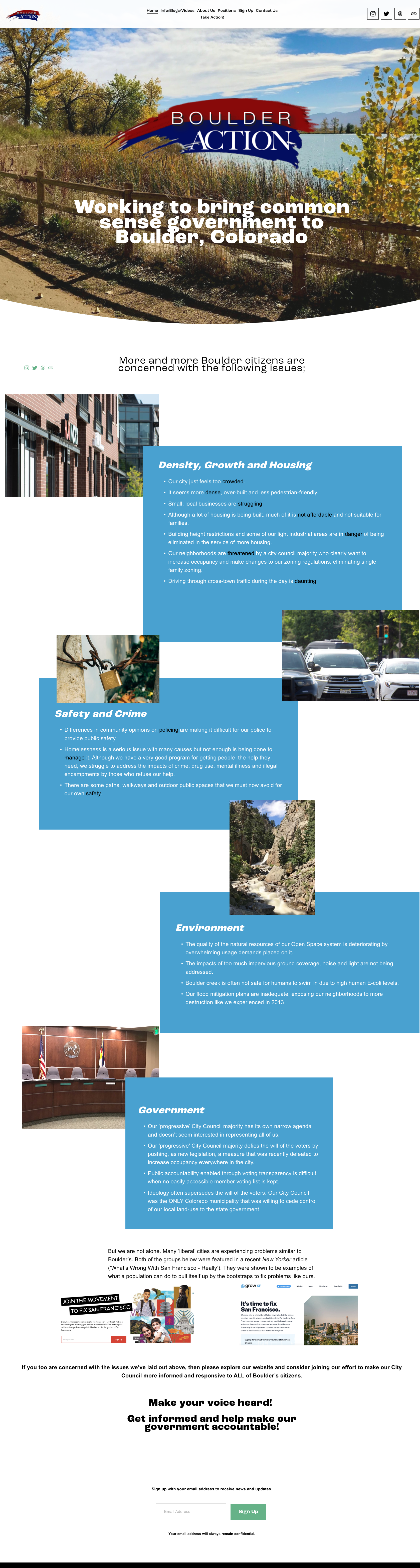
On the homepage (see the bottom of this post for a screenshot) they have an info box about Density, Growth and Housing. Let's look at each bullet point:
- Our city just feels too crowded. Not to belabor the point, but one person's too crowded is another's too empty. This is almost meaningless and impossible to measure. It's vibes. More specifically, how do they propose making it "feel" less crowded: depopulation? The only American cities I can think of that depopulated did it for negative reasons such as loss of jobs, or major pollution events. Is that what they want?
- It seems more dense, over-built and less pedestrian-friendly. Vibes! Whoever wrote this copy needed an editor. Two of these topics can be measured (there's no "seems" at all): density and pedestrian-friendliness. Measuring density is obvious, but for pedestrians, I'd think that this can be measured by ability access to destinations by foot and the danger of being injured as a pedestrian. I think that more density correlates with pedestrian friendliness, but it would seem that they don't, which is a tell I'll return to later on
- Small, local businesses are struggling. This may be true, but this needs data compared to local and national trends. Is it any more true now that it was before? Can it be explained entirely by the city council encouraging development? Without data, this is just a vibe.
- Although a lot of housing is being built, much of it is not affordable and not suitable for families. I'd take issue with "a lot of housing," but it probably feels that way to NIMBYs. The cost of the new housing is definitely higher than most would like, but some of the solutions to make building housing cheaper (removing single-family zoning, easier permitting process, no parking minimums, higher density limits, etc) are anathemas to NIMBYS. Their preferred policies directly contribute to the high cost of building housing. Furthermore, the single-family neighborhood of detached homes is not the only suitable place to raise a family. The second half reveals the lack of imagination of the Boulder NIMBY; they can't fathom that not everyone wants to live the way they've chosen to live
- Building height restrictions and some of our light industrial areas are in danger of being eliminated in the service of more housing. Maximum building height is a special topic for the Boulder NIMBY. Being able to see the mountains from anywhere in Boulder is super important to them. I find it fascinating: "we'd like to build more housing so people can afford to live here," and the NIMBY answer is "no, I need to see the mountains from everywhere." I'm not sure about the concern about light industrial areas except as a way to argue against zoning/development changes in general
- Our neighborhoods are threatened by a city council majority who clearly want to increase occupancy and make changes to our zoning regulations, eliminating single family zoning. Well, yeah, duh. Single family housing is probably the top reason why there's a housing crisis. The problem is NIMBYs act like getting rid of single family housing means iron foundries will be built in residential areas. No one wants that, but would it be so bad to have more (any?) missing middle housing in residential neighborhoods? Will a triplex cause your neighborhood to descend into a slum? A corner coffee shop or salon/barber wouldn't ruin your neighborhood, I guarantee. Notice that they cite the "city council majority." I remember voting for the city council and many of the current members openly campaigned on doing the things these NIMBYs dislike. This is how democracy works, folks
- Driving through cross-town traffic during the day is daunting. Here's the big tell of these NIMBYs. They expect to be able to drive in town during the day and not encounter traffic. Above they complain about the city seeming less pedestrian-friendly, and here about traffic. Any measure to make the city more car friendly is certain to be less pedestrian friendly. They want to be able to drive without traffic, and want a pleasant walk where they choose to walk, and they don't care about where other people might want to walk if it makes their drive "daunting." The only want to accomplish that is if their walks never go to any destination one might drive to because cars and pedestrian accommodations are opposites in cities. Making space for cars means taking it from pedestrians, cyclists, and other modes of transportation
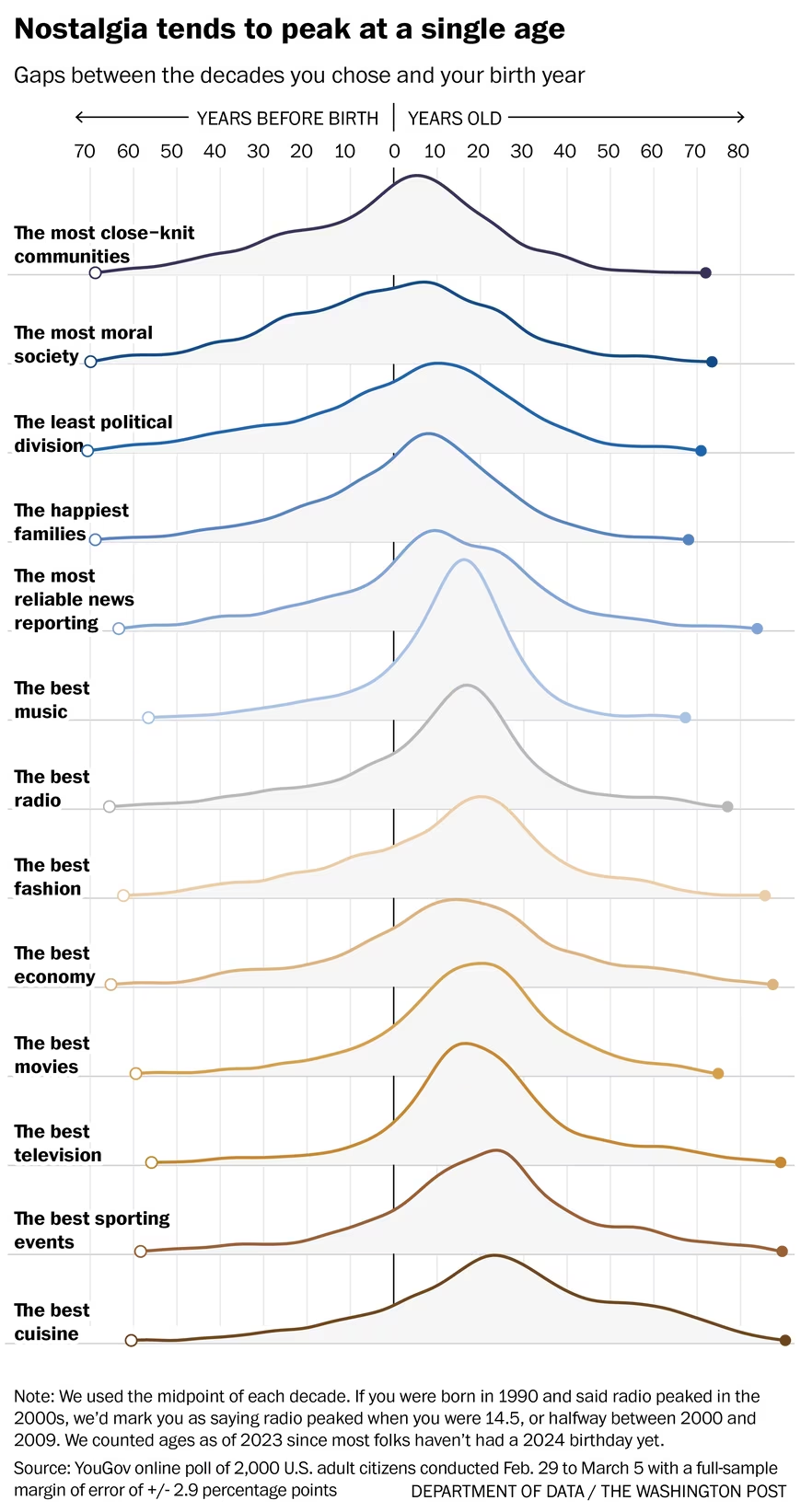
There's more on that page, but I'm going to stop here. I think all of this boils down to NIMBYs being selfish and not accepting that places change. I saw the graphic below some time ago, and I think of it often when hearing NIMBY complaints about change. Things (vibes!) were just better in the past, and anything that is change is bad.
Finally, because the group is so new I suspect that the Boulder Action webpage will experience change in the near future. I've put a screenshot of how the page looked when this post was written here.
Vote!
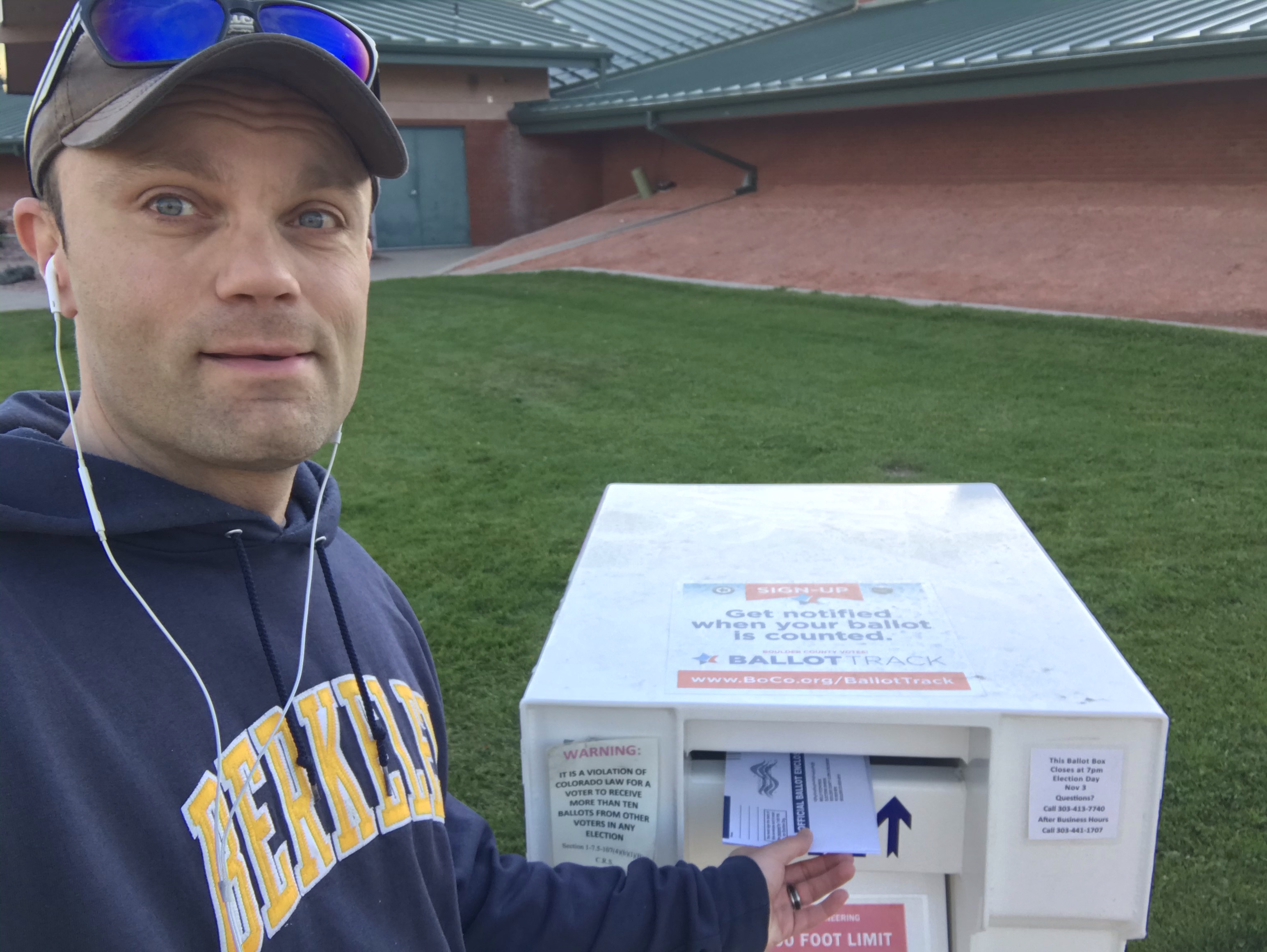
Vote early! Vote often!
Poorer than a CEO
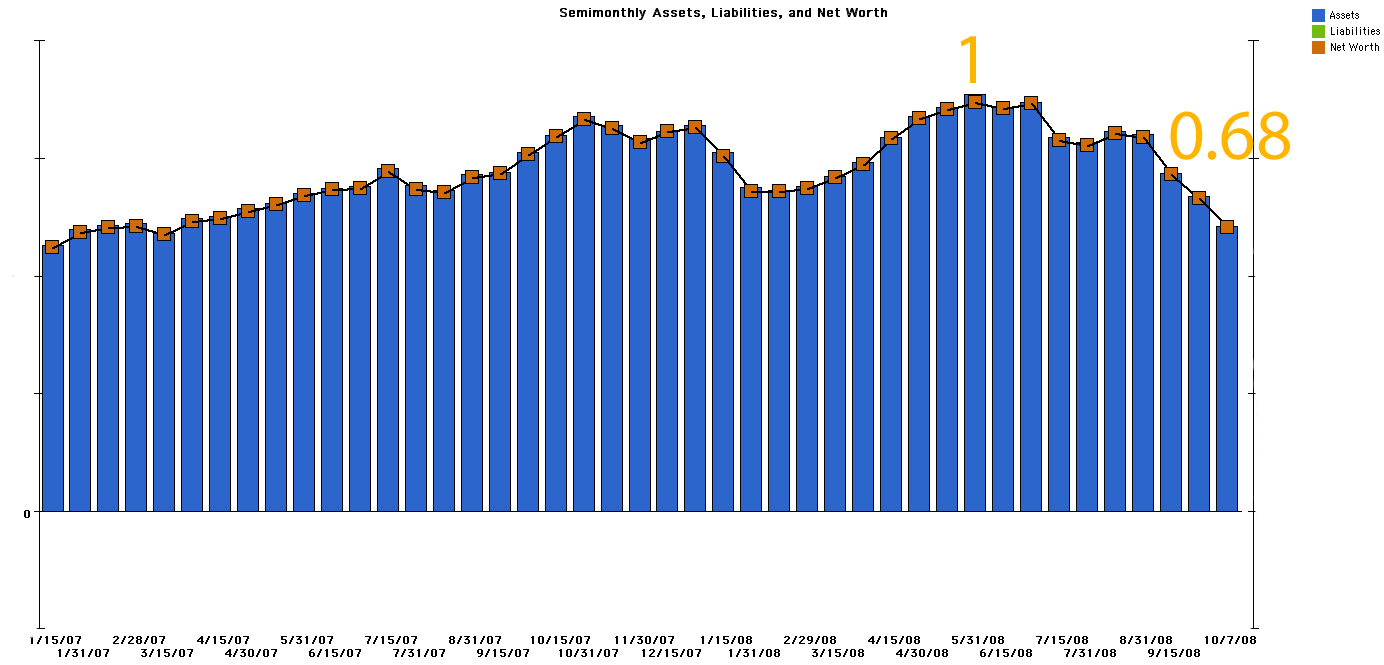
Above is a graph showing my net worth since January 2007. I have removed the actual dollar values for the bars because I'm ashamed of how poor I am. Or wealthy I am. I'm not telling. But remember that I'm a grad student, not a former CEO of a failed investment bank - you get the idea.
I've put two numbers in orange on the graph. If in my richest half month I had one dollar, now I have 68 cents. Put another way, I'm now about two-thirds of my former self, and this took five months. The graph above includes my cash accounts, which haven't gone down, so my investments have declined even more than a third. Luckily, I don't need that money any time soon (I have to graduate before that), but it's a bit depressing.
It's also an opportunity to buy some really cheap bank stocks and hold them until they recover. Which would more or less cancel out the inevitable tax increases my generation will have to pay to bail out our selfish parents.
At least I can say that I'm ahead of the curve on the grad school thing.
Uncle Dubya’s Money
I finished my taxes over the weekend and I discovered that in 2007 I made a whopping three dollars more than in 2006. Three dollars is three dollars, right? Not so fast, according to this page, I actually made an inflation-adjusted 5% less in 2007 than 2006. Good times for grad students!
Actually, it's not quite that simple. In 2006 I was paid more for a higher-earning TA position (66% vs. 50%, for those of you in-the-know), and in 2007 my investments covered that difference. So unless the economy collapses (it's possible!) I can count on my investments continuing to pay off in the long run.
TurboTax told me that I can expect a $600 check from the Treasury. I am sophisticated enough to realize that money is never free. As the government is already running a huge debt, this largesse is just more debt. And who gets to pay for this, why, I will! Depending on the next few congresses and presidents, it could be sooner or later, less or more, but in the end the $600 is not going to be free to me.
So, I give to my dear readers, a list of what I can do with Uncle Dubya's Money:
- Save/invest the money to prepare for the eventual increase in taxes that has to come.
- Buy some more RC helicopter stuff. I haven't flown my helicopter since December mostly because I've been forcing myself to focus on school. But also to keep me from spending too much money on it. With this money I could upgrade the parts, buy a bunch of spares, or buy a whole new toy! Like a nitro-power RC car.
- Buy a flat-screen television. But then I'd have a nice TV, and I could watch what on it? I'd have to pay for cable or satellite, or buy a Blu-Ray player.
- Convince Melissa to use her $600 with mine and we could do something really fun, like a trip to Europe. Except then we'd be spending all our money on either airfare or in a foreign country, which isn't the point of the money, right? And what with today's weak dollar $1200 buys approximately a nice dinner in Europe. At McDonalds. Maybe Burger King.
- I think now is the time to enter the housing market. The $600/$1200 could go for a down-payment on a nice condo here. And in a couple years we can sell it for huge profits due to the raging San Diego real estate market. A good idea? Maybe not.
2008 Presidential Primary
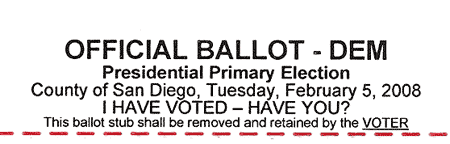
Today is my presidential primary, even though for most Californians it's on February fifth. I am a permanent absentee voter so I got my ballot in the mail yesterday. Besides the convenience of voting at home, I advocate absentee voting because it guarantees a paper record of your vote. All the paperless voting systems out there cannot be trusted. I'm not worried about fraud and conspiracies, I'm just familiar with how fragile most computer systems are. Without a paper record that the voter visually verifies before locking in their vote, I will never use a computer voting system.
Another benefit: now I get to ignore any and all advertisements that will be flooding the airwaves in the next four weeks.
Identityright
There are two stories that are big in the news right now, the Hollywood writers strike and identity theft. They aren't related, but I see them as almost the same issue.
Hollywood writers are striking to force the producers of scripted shows to share online revenues with them. As long as you agree that the writers are due residuals for their work, it makes sense for them to demand their fair share. The producers say that there isn't any money online and therefore are standing their ground. (Side note: If there isn't any money online, why are the producers not willing to give a percentage of nothing?)
Copyrights are a big deal, that's the base of Hollywood's riches. Hollywood has fought hard to preserve these riches by convincing Congress to pass questionable legislation to protect these rights. Recently a professor at the University of Utah calculated that over a normal day he commits $12.45 million in liability - and he doesn't even use P2P software. The point of the study is that copyright laws are so ridiculous that ordinary, everyday activities that everyone feels are fine are illegal, so the laws should be changed. Simply making a copyrighted work available for infringing is illegal. My point is that congress has agreed with the content owners enough to enact these highly punitive laws that nearly everyone agrees are insane and no one respects.
Over the last few years there have been numerous cases of personal information being lost or stolen from governmental or private sources. Hard drives and laptops are lost and websites cracked. There are also the simple cases of dumpsters with unshredded confidential information. People are having their identities stolen every day which costs them time and money.
The parallel between copyright and what I'm calling identityright is this: we need laws to punish those who lose confidential information to the same extent we punish copyright infractions. Just like a person is criminally liable for simply making works available for theft, companies (and the government) need to be criminally liable for making identity information available, even if no harm has befallen the individual. If the CEO of a company was personally liable for any lost information, you can bet identity theft would decrease almost overnight. Just like the Hollywood writers feel any use of their creative work deserves compensation, I feel that any misuse of my identity gives me cause for redress.
Is this idea any more ridiculous than the current copyright laws?
9/11! Terrorism!
Five years ago, I was not yet a college graduate. Now I'm beginning my fourth year of graduate school. I have a masters degree in physics, I'm on my way to a PhD, I'm more or less self sufficient and I am in a stable relationship. I can safely say that I've learned much in the last five years.
This cannot be said for the DHS. It is run by a bunch of morons. Take this news peice from today: "Cell phone makers fight resales." People are buying cheap handsets meant for by-the-minute cell plans and shipping them to foreign countries for resale at higher prices. The US is one of the few places in the world where cell phone companies subsidise the cost of the handset, hoping (rightly) to recoup the cost in the monthly service charges. However, because these phones are sold without a contract, and are not yet activated, there's no assurance that the person buying the phone will have to make monthly payments. Clearly, and logically, the phone companies are bothered by this.
So why does the DHS care about this? Why, terrorism, of course! 9/11! Terrorism! All these phones could be used for remote detonation devices. Yeah, and so could a Dale Earnhardt Jr. NASCAR Radio Controlled Car for $9.95 at Radioshack. Seriously folks, if a terrorist wanted a cell phone to detonate a bomb, does he need to buy dozens at once from one store? No. Terrorists want to act on the down low, which means buying perhaps one or two at any one time. They don't want to attract attention because they're doing illegal things. The people buying 20 phones at once don't care about seeming out of the ordinary because they are breaking no laws. It seems the en vogue thing to do that if your business model is in jeopardy, cry "terrorism!" and hope the DHS and their bad logic comes to the rescue. In this case, the DHS proves once again, they are unable to recognize legitimate threats.