My Cycling in 2024
2024 was a pretty good year for me in terms of cycling. Late in the year I purchased a new road bike which is only the third road bike I've ever owned (I bought my first racing road bike in 2001, a Trek 5200 in black with Rolf Wheels). But most of all I managed to increase the hours of cycling from 2023 by over 50%. For me, the enjoyment of cycling is proportional to the time I get to do it, so this increase has been great.
2024 was my twentieth year using a GPS to track my rides. In April 2005 I started with a Garmin Forerunner 301. Garmin had been making GPS receivers for years and this was an early athletics-focused device. Compared to modern devices it was imprecise and buggy (especially the heart rate monitor), but it was still very cool. I was a pioneer of "out front" bike mounts when I jury rigged the 301 to my handlebars. Not long after moving to Colorado in 2010 I upgraded to a Garmin Edge 705 that was bike-specific and had a host of upgrades, including maps, a cadence sensor, a color screen, and a barometric altimeter. A couple years ago I upgraded again to a Garmin Edge 530 which is even more accurate with the addition of GLONASS and Galileo compatibility.
I started using GPS in 2005 a full four years before Strava existed. A few years ago I took the time to upload my full history to Strava including activities that predate Strava. It's kind of fun looking at these old rides, I have historical KOMs all over San Diego. They have long been claimed by other riders, but because I was the only one using GPS back then I was the fastest!
Below I've compiled some statistics in bar chart form covering all my rides with GPS data since 2005. There are a few very clear trends:
- Through 2010 the activity trend is downwards as I sacrificed riding time in the interest of finishing my PhD (2005 is lower simply because I didn't get the Garmin until April)
- My peak year is 2011, my first full year after finishing my PhD and my second to last full childless year
- Totals continue to trend downwards with another child in 2016, and then only start to rebound in 2019 and ongoing as the children get older and require less attention
- 2018 was super rough; only 28 hours of recreational riding over the whole year
The bottom two graphs, the average speed (KPH) and rate of climbing (Meters/Kilometer), show some interesting things:
- All the years with better than 24KPH average speeds are years I think I preferred road cycling over mountain biking. For example, in 2019 I got a new mtb and I wanted to ride that all the time. Mountain biking is way slower than road biking and 2019 has the lowest average speed
- Correlated, I think all the years with more than 12 meters / kilometer of climbing are years I preferred mountain biking. Again, 2019 is an outlier because I did proportionally more mountain biking
- Years before 2010 are mostly in San Diego. It's hard to disentangle the fast speeds 2005-2007 between being younger, still racing, doing less elevation, and less mountain biking. San Diego is not flat, but it's harder to get the kind of elevation changes available along the Colorado front range
I have not included the distance I commute by bike in these plots because I can't be bothered to turn on GPS tracking when I commute. It's likely that each of the last few years, perhaps since 2019, I've commuted 500-1,000 KM by bike each year.
The plots below are interactive thanks to Plotly, a tool I highly recommend!
Back in San Diego (Temporarily)

I'm back in San Diego for the next week and a half in order to graduate. I defend in one week on the 27th. The photo above is of a tarantula that lives in the office that I used to sit in, and that I am sitting in again while I'm here. That is its full significance to this post.
If the tarantula isn't big enough above, you can make it bigger by clicking on the image!
Busy Times in Colorado
It has been nearly a month a half since my last post about leaving San Diego, and we've finally made it to Boulder! Ok, actually it didn't take that long. It took us two days, with a stop overnight in Saint George, Utah. The long gap in posting is due to how busy I've been here in Boulder, which has been nearly entirely due to getting my thesis done, but also to a good deal of work getting the new apartment put together. Those things deserve their own posts, which may or may not happen.
What I would like to post here are some pictures I took on my bike ride yesterday. I am 99.7% done with the draft of my thesis which I'm sending to my advisors this weekend, so I figured I could take some time to ride my bike recreationally. This is a novelty for me recently. Come wintertime, I'm definitely going to miss the weather in San Diego, but right now, cycling here definitely beats San Diego. It takes less than ten minutes to get out of town onto roads like this:
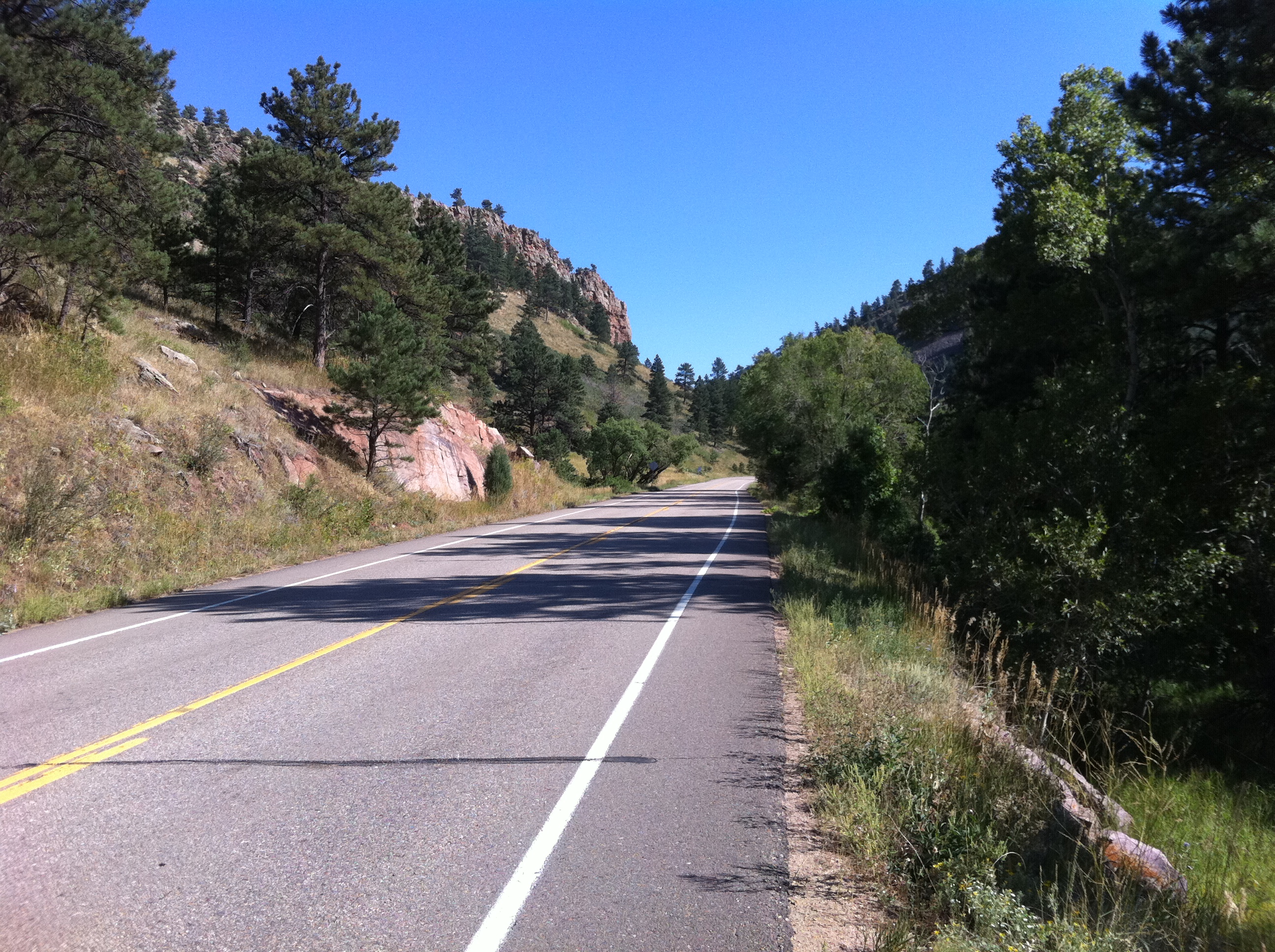
or this:
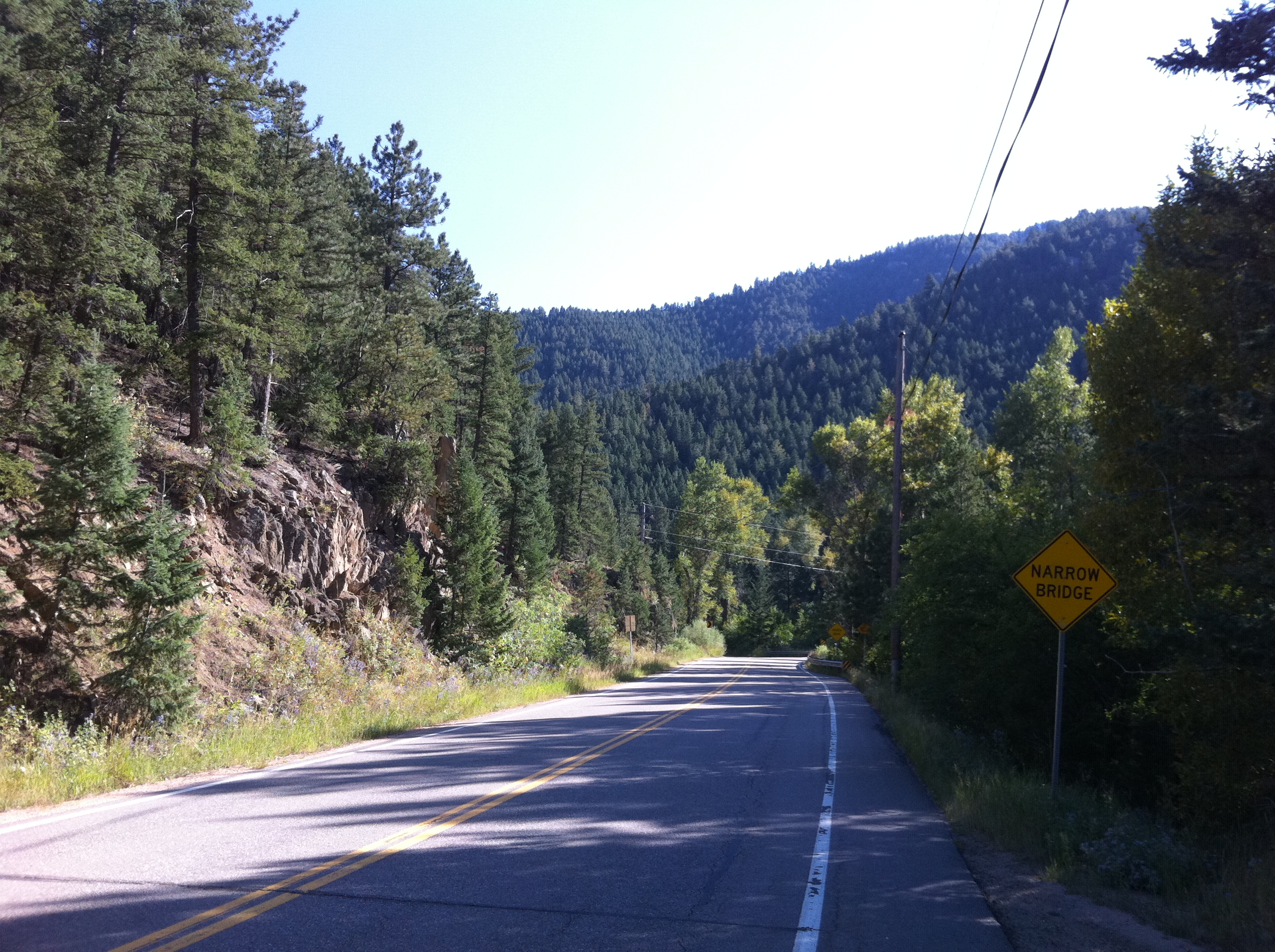
or this where it feels like I can see all the way to Kansas over the plains:
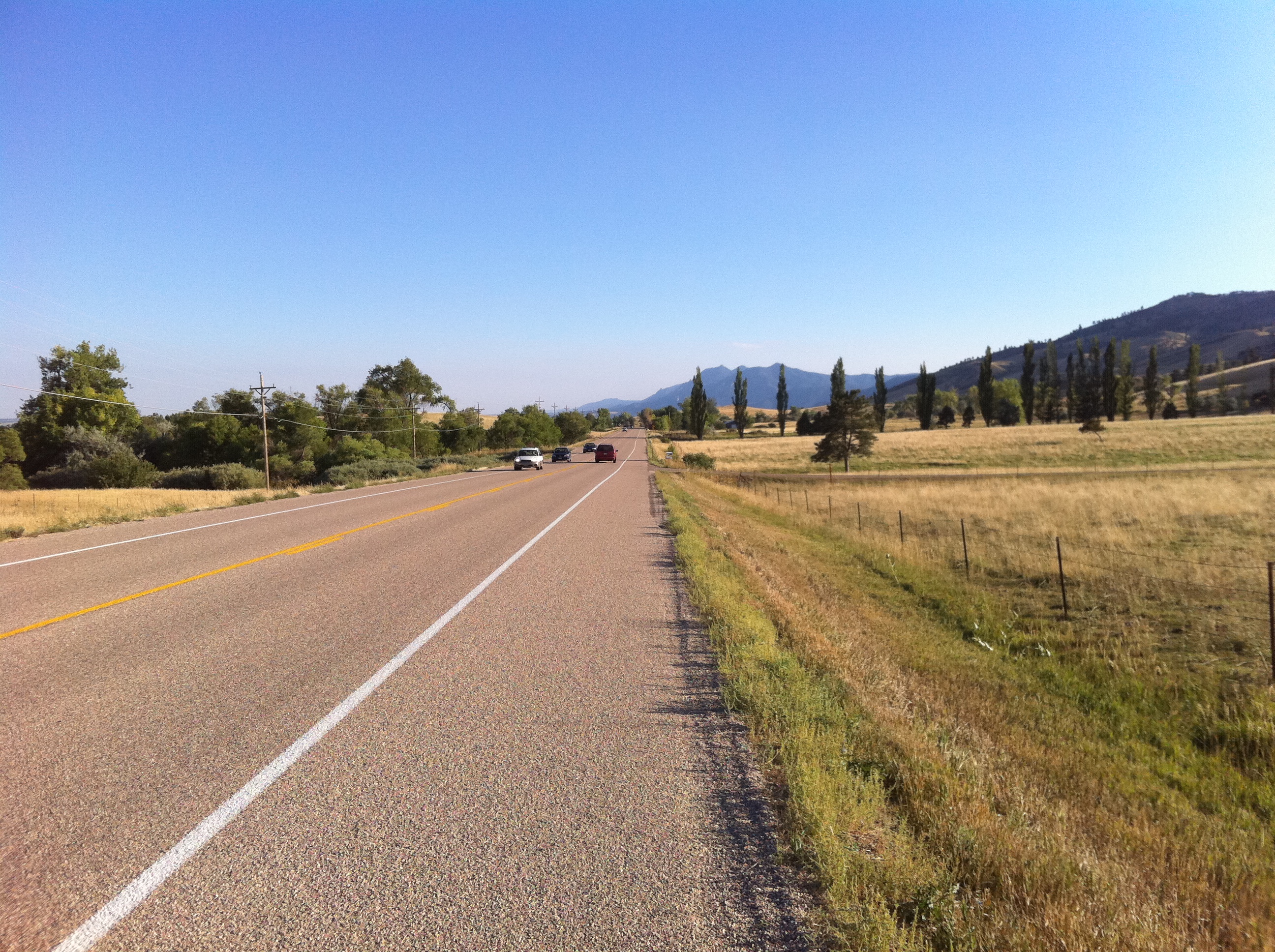
I just wanted to share. Hopefully, now that the bulk of the thesis is done, I can enjoy this area a bit before winter hits!
Leaving San Diego
Today we're driving from San Diego to Boulder. The various mapping services give the drive time on the order of seventeen and a half hours. Most of our things have been picked up by the movers and we're only carrying the things we need, can't replace, or is alive. The movers were supposed to have come yesterday so we could leave yesterday, but there was armageddon traffic on I-5 so they delayed coming today. The apartment is empty and we've turned in our keys.

Not really how it looks in the middle of July, although it did drizzle this morning
I'm sad to leave San Diego, it has been a very good place to live for seven years. I'm leaving behinds lots of friends and a place I'm used to living with weather I like. Boulder is an exciting new place with new friends to make. It has four seasons, which will be a new thing for both of us. I don't know if we'll ever live in San Diego again, but I do want to come back and see my old friends and go for a bike ride with them.
Goodbye!
Blue Angels Over Mesa

We didn't go to the Miramar Air Show this year. I've lived long enough in Mesa apartments to know the routine for the Navy's Blue Angels and that they they pass overhead several times. When I heard them pass the first time I went out with my camera to see what I could capture. This is the best picture I got. I see (and hear!) F-18s flying overhead daily, but never in such close formation so low to the ground, nor turning so sharply as when the Blue Angels are in town.
Mini-Vacation – Santa Barbara

Melissa and I are taking the slow route up to the Bay Area for the holidays. Tonight we're staying in Santa Barbara, and we'll visit the Hearst Castle tomorrow. For dinner we ate at a decent Mexican restaurant on State Street. Afterwards we walked down State Street looking at all the shops and restaurants. It's clear that the economy has started to hit Main, err... State Street America. Despite the Christmas decorations, and the huge tree in a left-turn lane, there are quite a few empty stores and others going out of business. I guess now is the time to start a new business cheaply in Santa Barbara - as long as you can weather the current economic storm.


More tomorrow!
Rainy San Diego
It's been really rainy and a bit cold here in San Diego so far this week. Here are some pictures I took today of the rain, and a couple of our xmas decorations.


Yes, that's a bike work stand in the foreground.
Finally, a Triton
UC Berkeley has bear statues, UCLA has their bruin statue, UC Irvine even has an anteater. Now UC San Diego has a Triton!

As I walked to lunch I saw the unveiling ceremony ending while the UCSD band (we have a band?) played the UCSD fight song (we have a fight song?). Below the statue there is a few streams of bubbly water and a plaque which explains that the Triton doesn't get to use his awesome trident, he just blows really hard on his conch which scares all the other gods and baddies away.
I, for one, am now waiting for the UC Santa Cruz banana slug statue.
SDSC Optiportal
My adviser Professor Mike Norman, as part of his job at the San Diego Supercomputer Center, purchased an optiportal system for the new SDSC building which is opening today. An optiportal system is a wall of monitors powered by networked computers such that the screens behave as one monitor. Very high resolution images and movies can be tiled across the screens, as you can see below. Movies and animations can also be tiled across the screens.
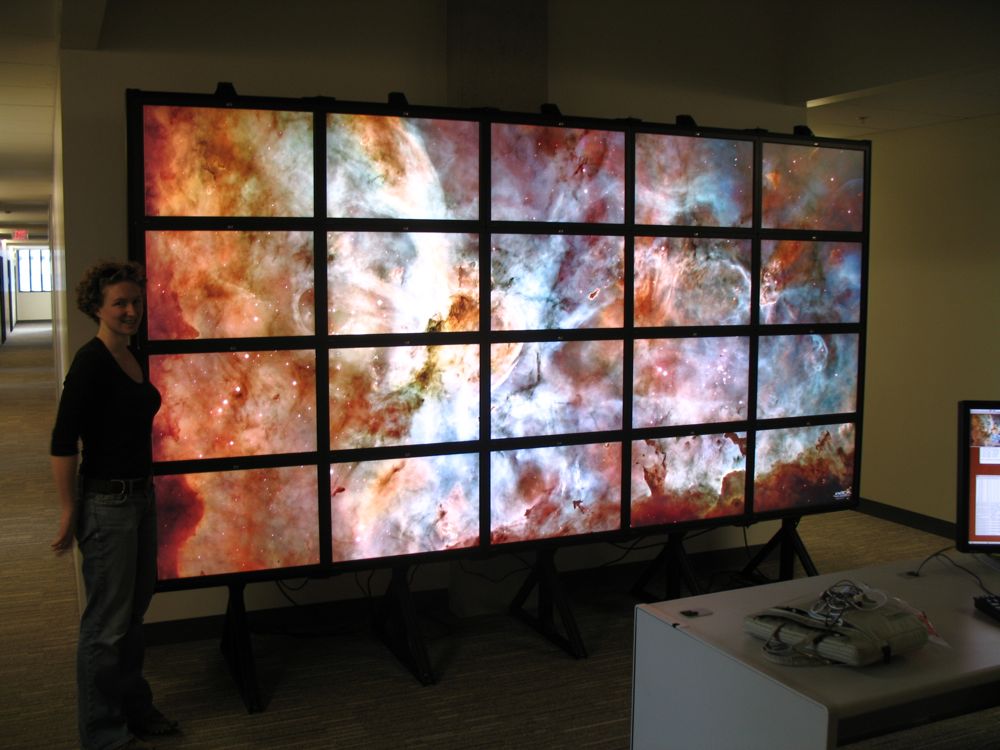
My labmates and I (Rick Wagner in particular) spent the last week feverishly building the system. The primary work was to build the monitor rack. It has many bolts and sliders and adjustments. We arranged to have two holes drilled through the wall for the monitor cables. The 30-inch screens require a very particular kind of cable and getting enough of the right kind that were long enough to reach all the screens was surprisingly difficult.
My main task was to convert some of the publicly available high-resolution astronomical images into tiled TIFFs. Tiled TIFFs break the data up into easy to scale tiles, which is essential for the optiportal. I used many of the images from this page (link broken), including the 403 megapixel Carina Nebula image linked there. It was quite frustrating. I tried half a dozen computers and iterations of ImageMagick and VIPS before I finally got a combination that worked.
In some ways, this is worse than a projector. There are gaps between the screens. This requires multiple expensive computers and many, many cables. However, there are some big advantages to this setup. There is no projector that has anywhere the same resolution as this optiportal (2560x1600x20 = 81.92 megapixels). Just one of the monitors is better than all but the most specialized and expensive projectors. The screens are bright and clear, even in normal lighting conditions. Unlike a projector, standing in front of the screen doesn't shadow the image. It has to be seen for yourself; twenty 30-inch monitors are awesome to behold.
Each four-monitor column is powered by a HP xw8600 workstation with one 4-core 2.33GHz Xeon processor, 4GB of RAM, two NVIDIA Quadro FX4600 768MB video cards with dual output, running Ubuntu 8.04 LTS. There is a sixth identical workstation that serves as a head node which sits in front of the screens and controls the output on the wall. There is also a HP ML370 server that has a 1TB RAID5 disk array, and has room for an additional 1TB. Eventually, all the machines will be connected by a 10Gb CX-4 network using a ProCurve 6400cl-6XG switch, and the head node and disk server will be connected to the outside world with a 10Gb optical connection. The monitor array is controlled using CGLX which is developed at Calit2, which is here at UCSD.
Science will not be performed on the optiportal, at least the major calculations won't. Instead, visualizations of simulations run on supercomputers will be displayed and analyzed. The human eye and brain is still a superior judge of the accuracy and meaning of data than a set of conditional equations. It is often necessary to actually see the raw data as clearly as possible. The point of the eventual 10Gb optical connection is that various parallel visualization programs like VisIt and ParaView will be practical. These programs do the data analysis on a remote supercomputer and the visualization is sent to the optiportal in real time for display. In this way, terabytes of raw data don't have to be transferred off the supercomputer, and the computationally intensive part of the visualization takes place on the supercomputer, which has far more processors, RAM and disk space than the optiportal. I hope to someday have some of my data displayed in this fashion.
A Rainbow over Mesa
Today it rained nearly all day long. As the sun was setting I saw this rainbow over the Mesa Apartments. I looked for gold - no luck. So I'm staying in grad school.
2008 Tour of California
...or rather, Tour of the Bay Area, Central Coast and North of L.A.


2006, 2007, 2008 route maps
In the three editions of the ToC so far, the closest it has come to San Diego is Long Beach, basically 2 hours away. That stage was on the fairly-boring Long Beach Grand Prix course. This year, the first four (of a total eight) stages are within two hours of the central Bay Area. Each are interesting. The closest stage this year to La Jolla is over two hours away, if the traffic is good in LA (ha!).
I am forced to wonder if the northward-tilt of the ToC makes good business sense. While the Bay Area is quite large at over 7 million people, the greater Los Angeles area and San Diego County together account for nearly 20 million people. Perhaps cycling is more popular in Northern California, but it would have to be three times more popular per capita to make business sense. Additionally, the weather is generally better in Southern California which would make the riders happier and the spectator turnout higher. Furthermore, Amgen, the title sponsor, is headquartered in Thousand Oaks.
I certainly don't think a race through downtown LA or San Diego is practical, but there are many roads in both areas that would make an excellent part of the race. I should know, I have ridden my bike on many roads I could recommend to the race organizers.
I will follow the race all the same, but I wish the organizers would bring the race near me at least one of these years (before the race evaporates, like every major American race eventually does).
North Mesa Apartments Lawn

Everyone likes a nice grass lawn. They're soft, aesthetically neutral, and you can recreate on them better than plain dirt or asphalt. They require lots of maintenance and water, but there are definitely situations when they're a wonderful thing, like in a large public park. You can play touch football on it, or croquet, or play with your dogs. You can also have a picnic on a lawn under a shade tree.
They are not a wonderful thing in the apartment complex where I live. San Diego is in the desert, even though we are next to the ocean. Nearly all of our water is imported from the Colorado river or points north. Water resources are finite and San Diego cannot continue to grow without heeding this fact. I find the lawn where I live to be completely ridiculous, and the photo above shows many aspects of why I find it so excessive.
- It has been raining almost once a week for the last few weeks, but not enough to make the kind of mud seen here. Furthermore, I see mud like this all year, including the summer when it never rains. These lawns are either over-watered, poorly drained, or on really bad soil.
- Just beyond the muddy track you can see some dead brown spots. There are spots like this everywhere. Too muddy here, dead just over there. Something is wrong.
- There are concrete paths between all the buildings. The maintenance workers drive around in little carts, usually on the paths. Even so, they feel their time is precious enough to cut off the paths and ruin the lawn like this. Why even have a lawn here when it's going to get ruined?
- In the corner of the photo you can see some entirely reasonable shrubberies that cover the minority of the ground in the complex. They require much less water and care then the lawn. I see them being tended only a few times per year, perhaps as often as once a month.
- Once a week I see a horde of men (I guess 4) on lawn mowers tear nosily past my apartment. Another day a week someone comes by with an edger, grinding the cutter between the path and the lawn. The next day the leaf-blower comes to blow away leaves and grass cuttings. By adding these up, my guess is that the lawn costs about six days wages per week. That's a more than a whole employee, and I get to pay for this.
- Because so many of the lawns are either muddy, or brown, I rarely see people recreating on them. It also has to do with the fact we're all graduate students and have other things to do (like write complaints like this). Since this isn't a city park, technically the surrounding community can't use it (there are "no dogs" signs at the entrances), so the number of potential lawn clients is small.
If things were the way they should be, there would be considerably less lawn coverage. There would be some lawns that were kept in good condition, well drained and large enough to recreate on. Places seen above would be turned into something less water and labor intensive, like a path, or native shrubberies.
Miramar One
10:36 playing time, 7629 frames, 41h41m, ~20s between frames, Nov 14-16, 2007
This is the first time lapse that I've time-stamped. I felt it was useful as without the time-stamp, it's hard to tell exactly what time it is, especially at night. It also allows you to see how traffic changes with each rush hour.
I think this time lapse would have worked pretty well with a very short interval, perhaps a second or less. Obviously, I couldn't have run it for nearly two days, but it would have converted the traffic from random noise to the main subject. The most interesting stuff happens in the second evening when various mists and clouds come in, so feel free to fast-forward to that.
The biggest problem with this time lapse is the huge number of frames don't actually contribute to the study. I could shorten the 10 minute running time by increasing the frame rate (or by not including all the frames), but at higher rates the traffic just looks even more random. Things would work better if the view changed much more smoothly.
2007 Collegiate Track Nationals Video
Above is a video I put together documenting the 2007 Collegiate Track Nationals. I put this race together over the last 10 months (along with a great deal of help from others, especially Chris Nekarda). Held at the San Diego Velodrome, over 100 collegiate cyclists from around the country competed over three days. My team, UCSD, did quite well, and at least one UCSD rider was on every podium.
Some notes: If I had planned my video a bit more before the event, I could have had done a better job (imagine that!). In particular, a few of my teammates are under-represented in the video, which was purely accidental. I would have liked to have a more even coverage of everyone.
More notes: I would have uploaded the video to YouTube, but there are too many copyrighted songs that would be blocked.
I hope you enjoy the movie. Thanks to Chris Schroeder for letting me borrow his DV video camera, and Chris Nekarda for a few still photographs in the movie.
Tropical San Diego

According to wikipedia and Weather Undeground, at 7:50 am today, the dew point in La Jolla was somewhere between "somewhat uncomfortable: and "quite uncomfortable." I would agree with that.
For over the last week San Diego has been subject to a flow of warm and humid air from the Gulf of Mexico. The temperatures haven't been all that high in absolute terms, perhaps as high as 30C (85F), but the humidity has been unpleasant. Furthermore, my apartment is uninsulated and has no air conditioning – so the windows stay open 24 hours a day. By the mid-afternoon, it's often a few degrees warmer in the apartment than outside. And our neighbors smoke on their patio about dozen times a day, which is annoying. It gets worse: One of the buildings next to us is having its roof replaced and all week the smell of fresh tar has been wafting inside the apartment day and night.
I usually don't complain about warm weather, I actually like it. But, lately, I'm looking for a little relief from the sticky humidity, the cigarette smoke and the tar.
(P.S. Of my faithful readers, my brother Adam has it the worst, of course, being in Vietnam right now. It's much more humid and oppressive there. However, Vietnam is 20 degrees farther south than here, so that's to be expected.)