2007 Collegiate Track Nationals Video
Above is a video I put together documenting the 2007 Collegiate Track Nationals. I put this race together over the last 10 months (along with a great deal of help from others, especially Chris Nekarda). Held at the San Diego Velodrome, over 100 collegiate cyclists from around the country competed over three days. My team, UCSD, did quite well, and at least one UCSD rider was on every podium.
Some notes: If I had planned my video a bit more before the event, I could have had done a better job (imagine that!). In particular, a few of my teammates are under-represented in the video, which was purely accidental. I would have liked to have a more even coverage of everyone.
More notes: I would have uploaded the video to YouTube, but there are too many copyrighted songs that would be blocked.
I hope you enjoy the movie. Thanks to Chris Schroeder for letting me borrow his DV video camera, and Chris Nekarda for a few still photographs in the movie.
Looking Fast
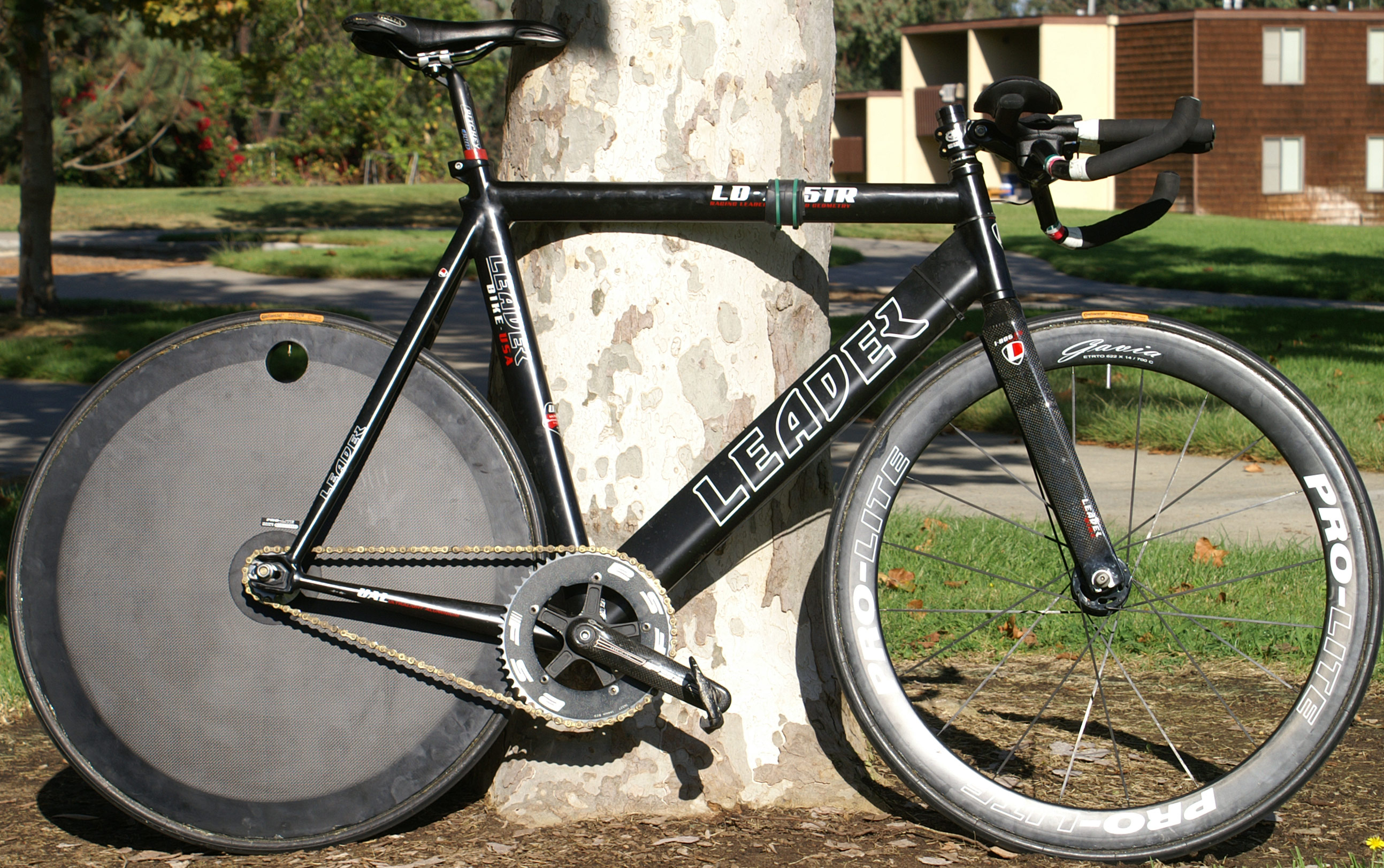
As you can see above, my bike looks fast! I just hope that looking fast will make me fast.
I finally have my Pro-Lite wheels on my track bike. The rear wheel has an interchangeable hub for road and track setups. It came with the road hub installed, and it was supposed to have come with the track hub part in the box. It didn't. It also didn't come with the front wheel skewer, and brake pads, which it should have. I am borrowing the missing parts for the the next week so I can actually ride my wheels.
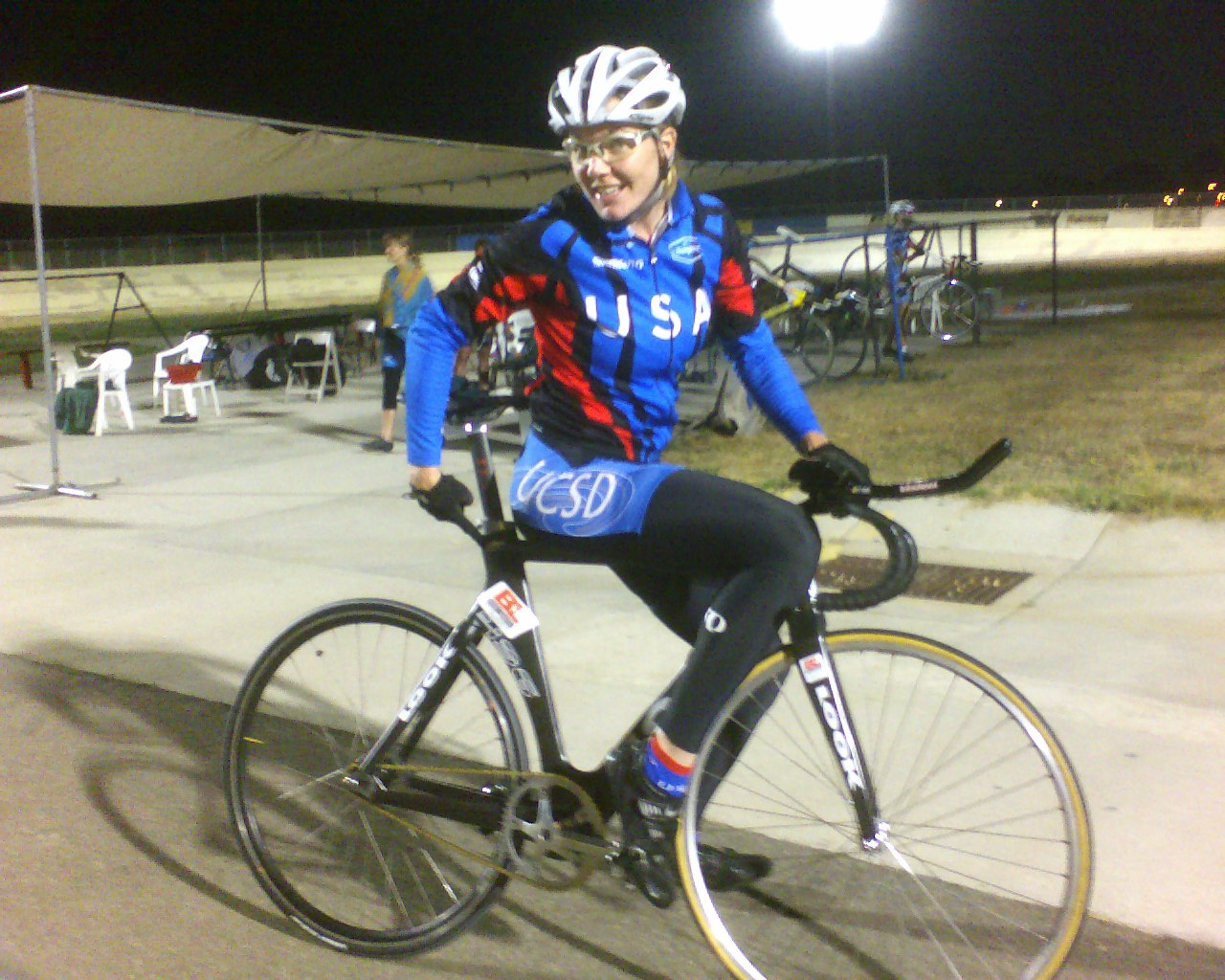
Speaking of nice bike stuff, take a look at Anna Lang's new ride below. Her sponsors are having her ride a $9,000 Look 496 Track Frame, which is just plain crazy. She's a graduate student like me, so that's a large portion of her yearly income. There's no way she would be riding it on her own means. Here's an article about this unique frame.
Leader Track Bike
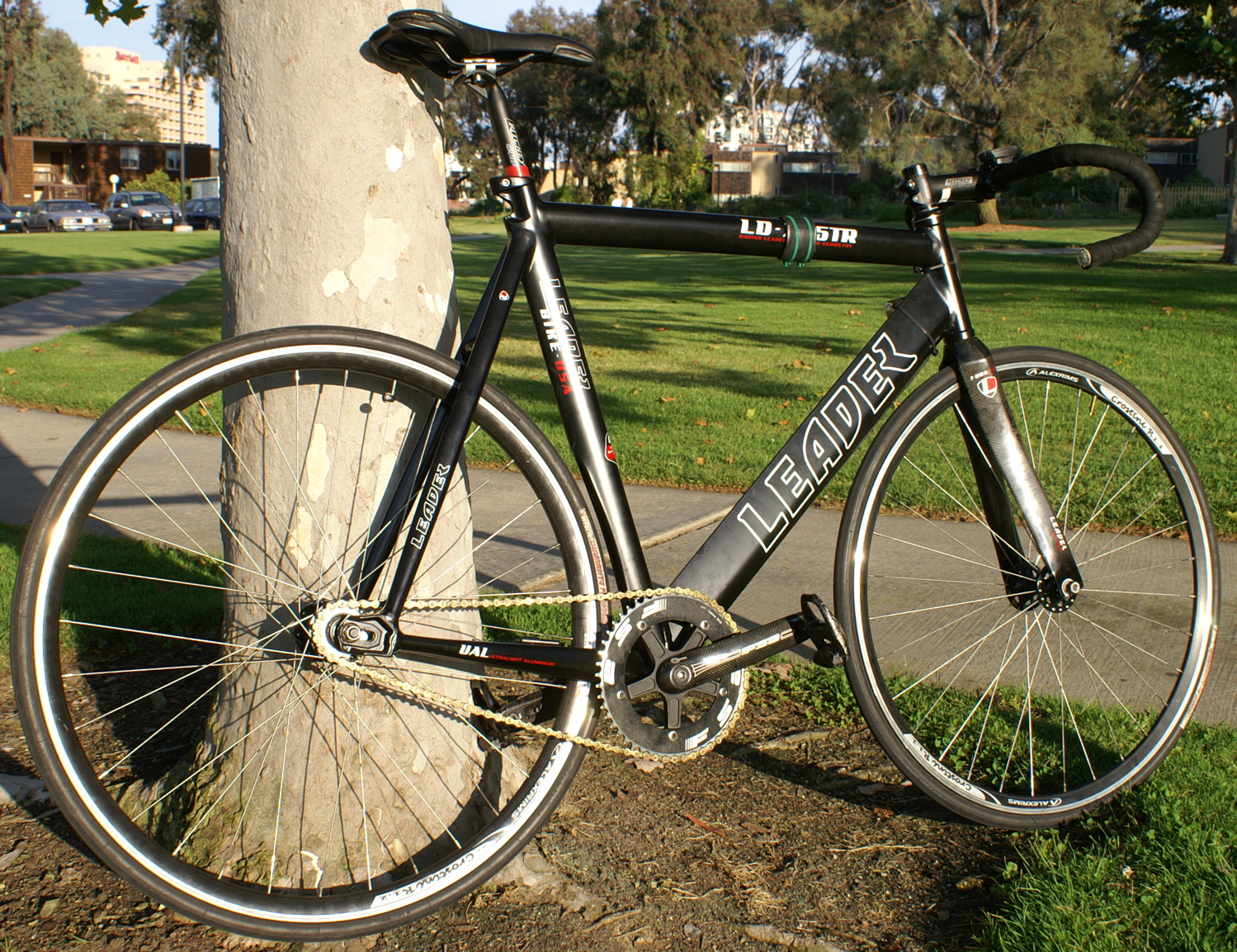
Yesterday I got the replacement frame for my Broken Fuji track frame. I got an aluminum LD 735TR 61cm track frame and carbon fork for a very reasonable price, especially considering how short notice it was. I have several friends who are riding Leader frames and they are happy with them. Happily, this new bike has considerably less red than the Fuji.
If you look at the full size image (by clicking on the image above), you'll see that I've placed a piece of an old tube around the top tube using two green zip ties. This is there to protect the top tube from the handlebars, which tend to whack the top tube. Regular bikes don't need this as brake and shifter cables help dampen the handlebar swinging motion.
When I put my Pro-Lite carbon disc rear and aero front wheels (which should arrive soon!) on this black frame, it will look awesome! And that's what counts.
Broken Fuji
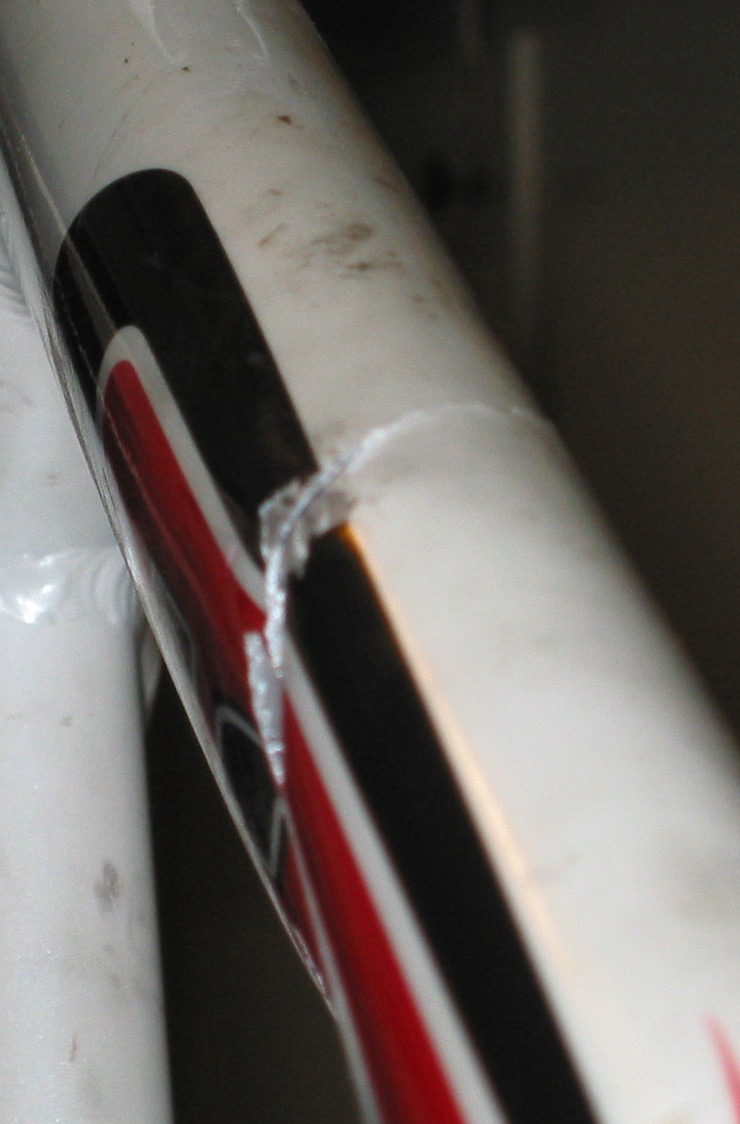
Almost a year ago, during my return trip from Indianapolis, my 2005 Fuji Track Pro was dented due to the TSA improperly re-packing my bike box after inspecting it. I managed to parlay this into an almost $1000 check from the TSA after documenting their liability quite thoroughly.
The bike wasn't actually fatally damaged. It still rode true and there weren't any cracks, just a dent. Aluminum tubes are strong enough to use as long as they aren't creased with sharp edges (this is what I have been told). For the last five months I've been riding my Fuji with a dent in the downtube with no problems -- until now. Now, I'm afraid, the bike has made it's last lap of a velodrome. Yesterday I found that the dent has turned into a crack that you can see. The crack starts in the dent and works around the bottom of the tube to the other side.
In my Fuji's lifetime it has seen four velodromes: San Diego, Hellyer in San Jose, Northbrook in Chicago and Major Taylor in Indianapolis. My cyclometer has 2850 km on it, which works out to 1770 mi. Most of my time has been in San Diego, which is a 333 meter track. Major Taylor is also 333m, while Hellyer and and Northbrook are slightly longer. I'll simply use a 333 meter lap. That odometer distance gives 6800 laps. I'm sure the actual number is quite different than that, but you get the idea. 6800 laps is a bunch of going fast, and turning left. And not forgetting to pedal.
Goodbye good friend!
Now I need to find a new frame, soon. Hopefully the new one won't have any red on it, my one dislike of the Fuji. When that's all sorted out I'll post a picture of my new single speed steed.
Top Fuel Cycling
With all recent news about doping in cycling (and everywhere else), including the whole Floyd Landis debacle, I think that it's high time to institute Top Fuel Cycling. What? Top Fuel?!
Here it is: Throw all doping controls out the window. Anything that doesn't kill you (immediately) is allowed. EPO, testosterone, human growth hormone, amphetamines, and many more. Finally, there will be no question about who's on the stuff and on the clear.
On the flip side, there will be a league for cyclists who aren't on anything. In fact, they'll be forced to live like an average american. They'll need to eat cheetos, or maybe the league will be sponsored by the Lance snack company. It will be in their contract that half their calories have to come from Lance snacks. The other half from soft drinks and beer. To top it all off, this league will be followed by a TV crew filming a reality series. Each week someone will be kicked off by a judging panel, made up of Lance Armstrong, Lance Bass, and David Hasselhoff.
Madison Madness
I've been riding bikes for so long that it's unusual that I learn something new. The last couple weeks I've started learning how to do the madison, easily the most insane event on the track. The madison, named after the arena in New York City, is a team event with two riders per team. One rider is racing, while one rests. In the multi-day race events, often one rider will ride for hours, and then switch off to the other teammate.
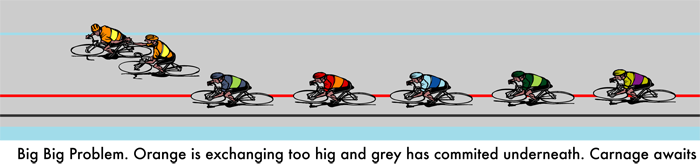
In shorter events, both riders are on the velodrome at once. The one who is resting either rides very slowly or holds onto the railing. When the racing team member wishes to be relieved, usually after a lap or two, the resting rider meets the racer, and they exchange momentum via a hand-sling.
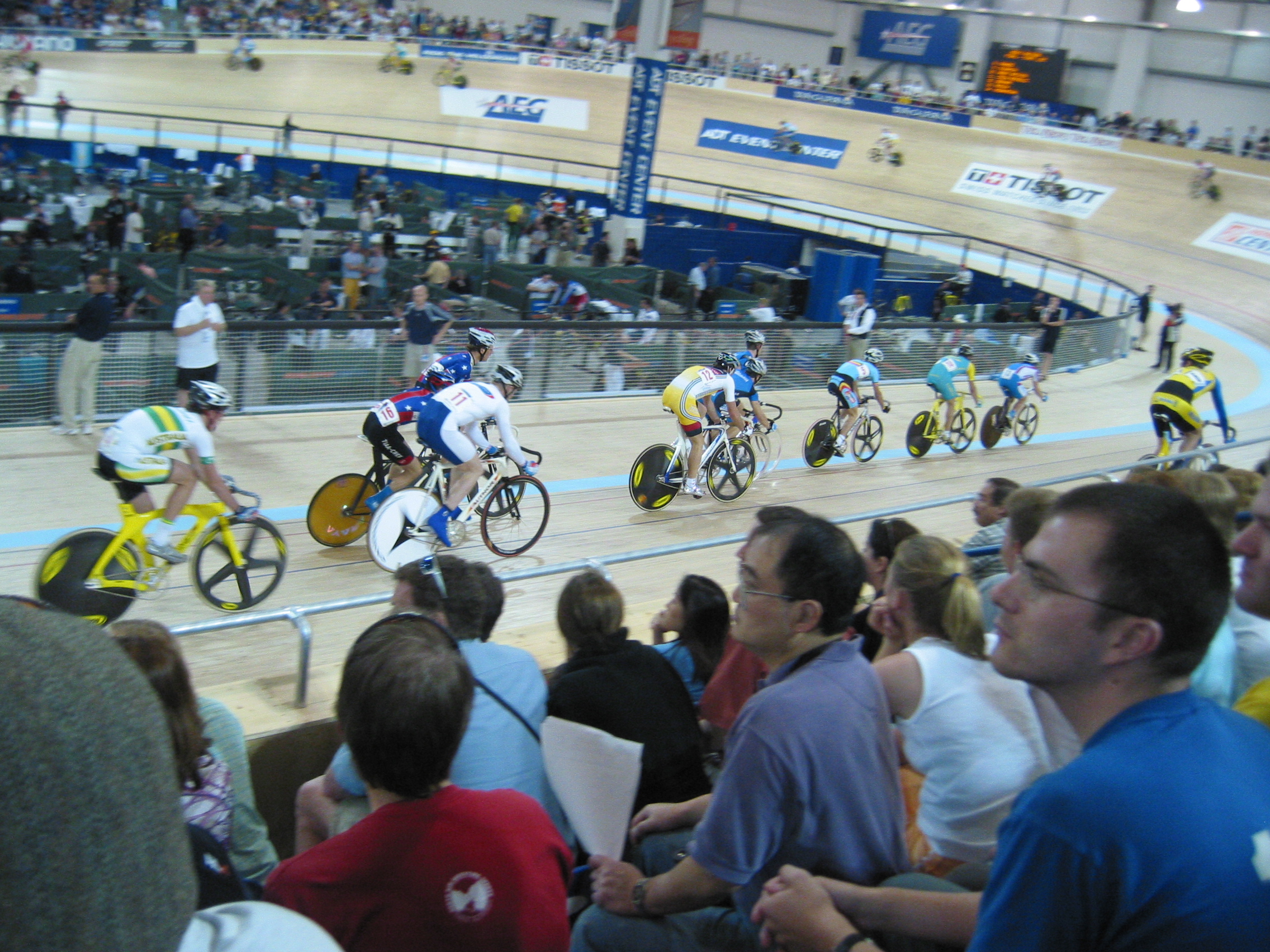
The thing that makes this event so darned exciting is the sheer number of things going on at once. Firstly, of course, there's a race going on. Then, you've got riders coming in & out of the event. Sometimes multiple riders are coming into the race at the same time, so positioning and timing is very important. Since it is a race where you're only going one or two laps, essentially a racer goes nearly all out, followed by a short rest.
Cycling Track Nats Addendum
A few more things to add to my post from yesterday about Track Nationals.
Here are some photos I took at Nationals that I posted on the UCSD Cycling website. Photos another rider took which are actually very decent and have a surprisingly large number of photos of UCSD. I don't actually know who took them, but thank you! (Update: They were taken by Steve McFarland of Tufts.)
Choice quotes from the weekend:
"Are you too good for your home?" -- A slightly delirious Ashley trying to fit her rollers in a bag.
"I don't wanna be a cowboy." -- Stephen before both points races (copying Joe Merlone, who probably copied it from someone else).
"Awesome!" -- What Ashley yelled at me almost every lap of the points race final.
I'll edit this entry when I think of more!
Track Nationals
I just returned from Chicago where I participated in my first national-level cycling competition. It was the 2005 NCCA Championships held at the Northbrook Velodrome (Google Maps), in Northbrook, a leafy suburb Northwest of Chicago. I participated as member of the UCSD Cycling Team.
My goals for the event were fairly modest because of my relative lack of track racing experience. My two individual events were the 3 kilometer pursuit and the points race. The 3k pursuit is a time trial, from a standing start. Alone you try to ride the distance as fast as possible. It's comparable to running a mile in terms of duration. If you go too fast in the beginning you'll be suffering at the end. It's about metering out your effort such that just as you cross the finish line you are at your breaking point. Two weeks ago I raced in San Jose and did a 4:06 pursuit, so my goal at nationals was to simply get below 4 minutes.
The points race is something like a criterium on the road, but usually much more brutal. Every five laps there is a sprint, and only the first four riders across the finish line get points. The field size is usually over 20 so obviously people go very fast for sprints. Each sprint, including the final, is worth the same points: 5,3,2 and 1 point(s) for first, second, third and fourth. The rider with the most points at the end wins. I have raced a bunch of points races this summer locally, and it was my best event, so I was looking forward to it.
I also raced in two team events, the Italian Pursuit and the Team Pursuit. The Team Pursuit is a four man, 4 kilometer race to the fastest time. Each rider takes turns at the front where riding is most difficult. The other three sit in the draft and work significantly less hard. Time is taken when the third man crosses the finish line, meaning only one of the riders can drop out of the race (usually because of exhaustion).
The Italian Pursuit is an interesting race because it's the only race with both genders. There is a minimum of three riders and a maximum of six. One rider has to be female and there can be no more than four males. Each rider leads the group for a lap, or two, and then leaves the race. The next teammate then does the wind-cutting duties until they leave. Time is taken when the last rider crosses the line for six laps. And a woman has to lead for two of those six laps (but it doesn't have to be the same woman). You can see that if a team has less than six riders, someone is going to go for two laps.
The team had a goal of reaching the podium on team rankings, meaning top five of all the teams. The way team rankings work is every race gives team points to each team based on how well their member raced. All the races and all the team points are added up together and the team omnium is decided. We wanted to be one of the five best teams. The team events I outlined in the previous paragraph are very important in the team omnium.
The racing was held for three days, September 29 to October 1, with a morning session at 9 am and an evening session at 6 pm both days. But you need to realize that for each session racers need to show up at least an hour before the start and often leave half an hour after the end of each session. I & my team were getting up at six each morning and retiring after 11 pm, which makes for very long days.
Did I meet my goals? I think I did. I raced a 3:59.4 pursuit. Of course I had aero wheels & an aero helmet, unlike in San Jose, which certainly helped. But it was still me pushing the pedals so I was happy. That time put me in 20th place (out of ~40 riders), which is the lowest place that gives team points, and that is what I was hoping for.
The points races were on the final day. Because so many men signed up for the points race, there were two qualifying races in the morning, and the best 13 of each would advance to the final in the evening. By the third day of racing I had developed a sore throat and persistent congestion, making everything unhappy. Leading up to the qualifying race I was very anxious about my ability to race in my condition, but I raced anyway.
The qualifying race was 45 laps, or about 17 kilometers (on a 383 meter track). Let me point out that the longest points race I had ever done up to that point was 45 laps here in San Diego, on a 333 meter track, or 15 kilometers. Luckily for me, despite my condition, I was still able to read a race. I guessed that the large rider in front of me (~6'-4") was about to make a dash for the sprint with about a lap and a half to go. Thinking that such a big guy makes a nice draft, I grabbed his wheel (figuratively), and sure enough, he went. After he pulled me around for a lap I went around him and ended up taking third on that sprint. It turned out that those two points were enough to advance me into the final.
The final was 75 laps, or nearly 29 kilometers. After racing the longest points race of my life in the morning, I raced one 77% longer 10 hours later. At this rate I'll be doing double century points races. Ouch.
Because I knew that with my sickness I was under full strength, my goal for the points race was to not get dropped and sprint for high placing in the final sprint. The finishing order in a points race is ranked by those who have points first, and then by finishing order. I knew that if I went for points during the race I would get dropped after the huge effort, so I had to save up for the end and get ahead of other guys without sprint points.
My plan worked pretty well because I got lucky, twice. With four laps to go a rider crashed in front of me. He was sliding from my left to my right with one foot still attached to his bike, and his bike was in front of him in the slide (imagine the bike is dragging him by his right foot up the banking of the track). In the microseconds I had to make a choice I aimed for that leg thinking it would be a better target than his body or his bike. Just as I was about to hit his ankle his foot separated from his bike and I went right between. The officials shot the gun twice to halt the race while the crashers were taken off the track, and during the lull in action I advanced about 20 places in the pack and settled in at about 6th or 7th place. When racing resumed I just had to hold on for four laps and sprint hard for the line, where I eventually placed 20th after the orderings were worked out.
If you had asked me the morning of the points races if I would even advance to the final, I would have been doubtful. I'm happy I pushed through my discomfort and did respectably. Now I want to come back and do the race healthy. I think I could do some damage if I was healthy!
The Italian Pursuit was a very successful race for our team. The way qualifying works in this event is the teams race in the morning alone for a qualifying time. Then, the two fastest teams face each other on the track at the same time in the evening for the gold and silver medal, and the 3rd and 4th for bronze. All the teams 5th and lower in qualifying are given that place in the final rankings. This means often your hardest effort is in the qualifying because you are guaranteed certain placing after that. We rode a very good race and qualified second.
In the final we raced a very skilled team from Penn State, which had no fewer than three "ringers," people I who I consider more bike racer than college student. Two of them only register in the fall to race at collegiate nationals. One of them I know for a fact spent most of last year in Australia racing, which is a goodly distance from Pennsylvania. This is to basically point out that we knew we had no chance of beating Penn State in the final, so we didn't race quite as hard as the qualifying race. Additionally, one of our members, Tona, was doing other races during the same session, so we wanted to keep him from over exerting himself. But we were very happy with second, especially because everyone on our team earned the second place.
The Mens Team Pursuit had a similar qualifying system, and we qualified fifth. We raced a very good, disciplined race -- something I'm proud of. Looking back I think we could have gone a bit faster and qualified fourth (0.6 seconds away), and that's something to remember next time we do that race. Qualifying fifth was a good and a bad thing. It was good because it meant we didn't have to race again (this was the same day as the points races), but it was bad because fifth isn't nearly as nice as fourth. We were in a tight battle for second place in the team omnium with Marian College and every little placing mattered.
Speaking of the team omnium, we ended up the weekend in third place overall, behind Penn State and Marian College. After Penn State, we had the most talented riders. Marian had over twice as many racers as UCSD, but beat us 800 points to our 792, a 1% difference. Marian also has cycling scholarships and a velodrome on their campus. They beat us with quantity over quality. This was the first year for UCSD going to Track Nats as a team, and we really made an impression around the country (well, to those who pay attention to Collegiate Track Cycling).
It was a grand adventure and really taught me about how hard I can push myself. Now I want more!
UCI Track Worlds
Last weekend I attended the UCI Track World Championships in Carson, CA (basically LA). It was awesome. It's amazing seeing such good riders because they make going fast look easy. When I'm going hard (which doesn't equate to fast) I don't look good, not like these riders. Of course, I took photos. Highlights:
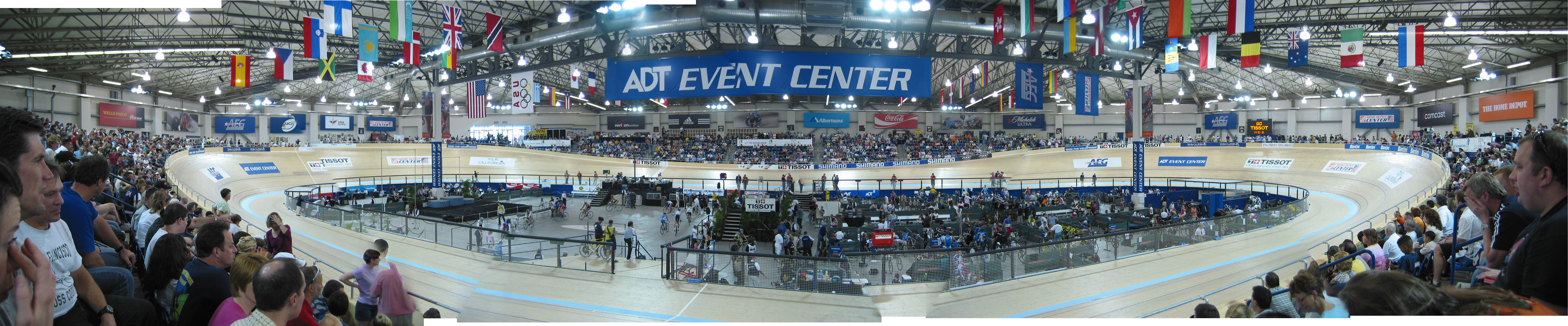
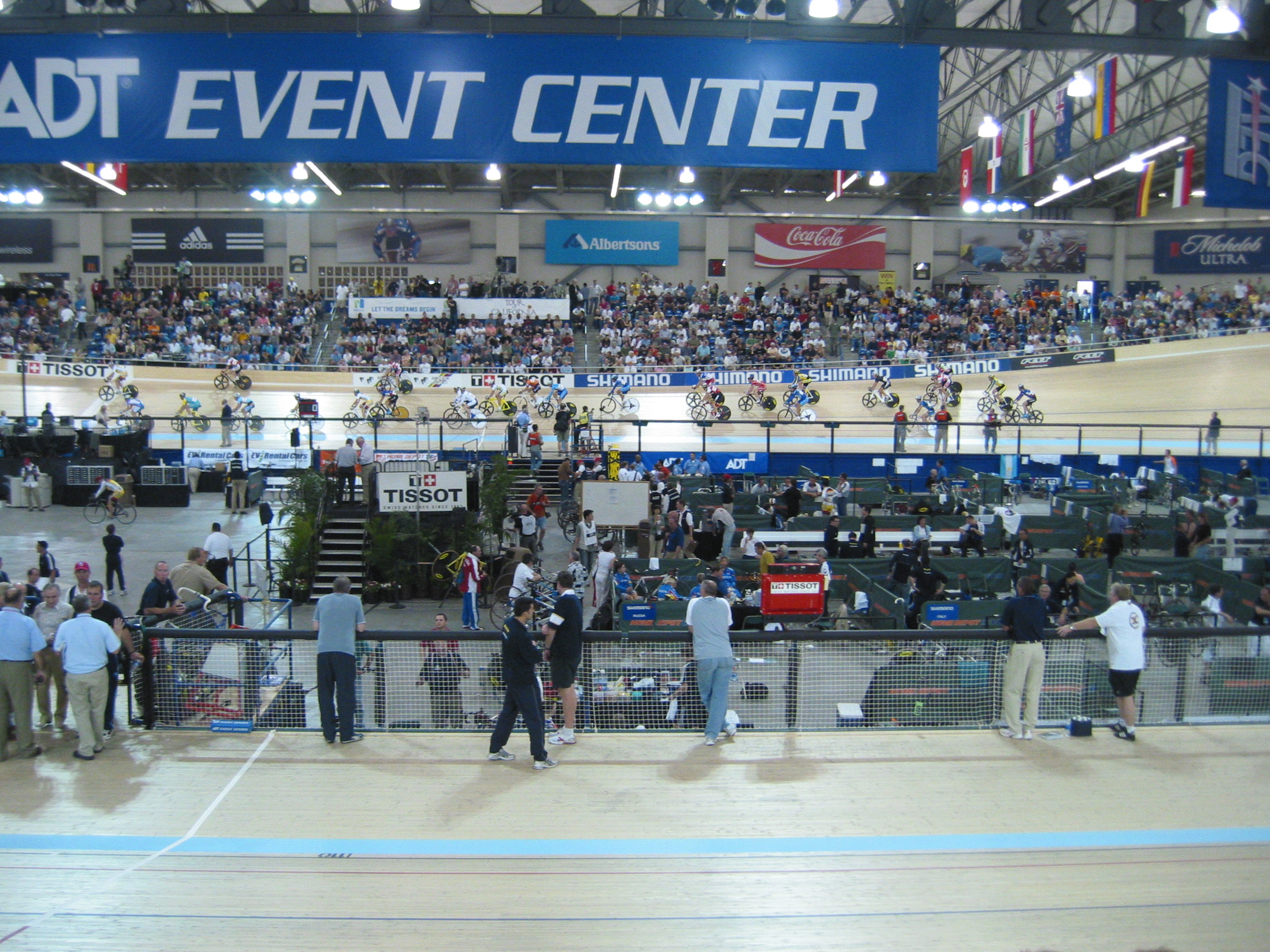
A not very clean panorama, but it gives you the general idea. The turns have a banking of 45 degrees. The track is 250 meters at the sprint (black) line. The track is made out of special siberian pine – so special that the whole arena is at a positive air pressure with constant temperature and humidity. There are about 6000 seats. It is by far the best facility in the United States. More Info.