Priority Commuter Bike
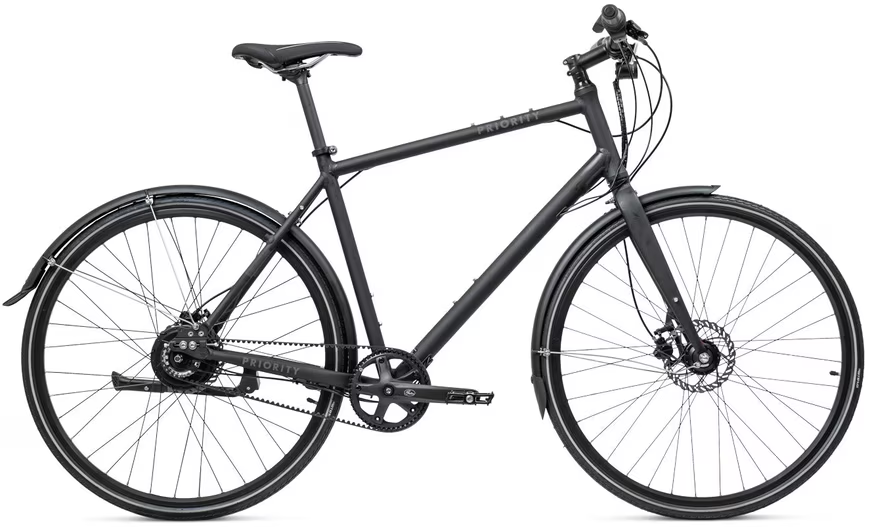
I realized that I've written here about my Santa Cruz MTB and my Orbea Road Bike, but that I never wrote about my commuter bike because I purchased it during the period when I stopped writing to this blog. Today I'll fix that omission!
In late summer 2020 I purchased a Priority Continuum Onyx to replace my Frankencommuter bike. My old commuter was a hodgepodge of parts: a Nashbar road bike frame (called the "Framé" and no longer available for purchase), along with various used bike parts I acquired over the years; mostly from when I upgraded parts on my bikes. It was fine for what it was but after using it for about ten years it was wearing out and I was ready for something nicer. There were aspects of the bike that could never be fixed. In particular, the inability to fit fenders to the frame led me to decide something else was needed.

After doing research I decided I wanted a belt drive bicycle. I was interested in belt drive bikes because all the positives (listed here) seem perfect for a commuter and the negatives unimportant, or at least less important than the positives. They are low-maintenance, long-lasting, and clean. There are negatives (listed here; more later), but even some of the negatives have positives. For example, it's impossible to shift gears on a belt drive using a standard derailleur. To have more than one gear requires an internal gearing system, often placed in the rear wheel hub. This makes the bike more complicated, heavier, and less efficient. However, because the gearing is internal, it's sealed away from rain and dirt and requires less maintenance, exactly what I want from a commuter bike.
Priority bicycles sells only belt drive models, and I settled on the Continuum Onyx. It had basically everything I wanted:
- Belt drive
- Continuously variable transmission (CVT) internal rear hub (more on this later)
- Fenders
- Built-in lights using a front-hub dynamo
- Hydraulic disc brakes
- Reflectors everywhere, including the tire sidewalls
- Upright seating with flat bars
- Forgiving 32C tires
- "Acoustic" a.k.a. non-electric. At home I have to carry my bikes up and down a flight of stairs and I didn't want a bike that weighed 50-60 pounds
About the only thing they omitted, and probably should include on a city commuter bike, is a bell. Like reflectors, bells are legally required in many jurisdictions (but never enforced, really). I have added a bell and it's useful.

The are definitely negatives to a belt-driven bicycle. The bike is fairly heavy, especially in the back (although I'm probably spoiled by my other quite light bikes). It's also clearly less efficient than a standard chain-driven bicycle. I am not as fast as I think I would be on a similar non-belt driven bicycle at a given level of effort. Many parts of the bike would be hard to fix on the go. However I only ride it in town, and worst case I'll leave it locked up somewhere and use my bus pass to get where I'm going and return for it later. Doing any kind of maintenance that requires removing the rear wheel is a decent hassle.
The CVT rear hub has its plusses and minuses. On the positive side, in contrast to a traditional derailleur, it doesn't require any fine adjustment. It uses a single grip shifter(*), meaning that the bike can reasonably be operated with one hand that can both shift and brake (e.g. you're carrying a pie in your other hand). Coming from typical bikes with set gear ratios the CVT is at first very weird, but being able to change the ratio by just a smidge is useful. The minuses come down to the same issues mentioned above: weight, efficiency, and difficulty of working with the rear wheel. In my opinion the plusses outweigh the minuses.
After four and half years of ownership, it has indeed been a very low-maintenance bicycle. Other than pumping up the tires once or twice a month:
- I recently replaced the brake pads (front and back) and bled the hydraulic brakes. I've done this before on my mountain bike, and once I figured out how to shimmy the bleed block into the brakes, it was actually easier than the Santa Cruz
- I can't remember the last flat tire, and I think I've had less than 5 flats overall
- The new (see below) kickstand spring mechanism gets gummed up with road grime and about twice a year needs to be cleaned out
I do have some minor to medium complaints about the bike that mostly consist of the items Priority saved a few bucks on:
- The factory-spec kickstand was flimsy and I had to replace it when it broke. I replaced it with a two leg kickstand (holy moley, how can someone write hundreds of words about a kickstand?) that is far stronger and better than the original one. The one I purchased is especially nice and I spent more than I could have, but the one Priority supplied was not very well made
- I'm on the third bottom bracket. For both previous the bearings holding the spindle went bad and the bottom bracket developed a very annoying click. It is likely that a higher quality bottom bracket would solve this issue
- The connector that links the dynamo hub to the wire that runs to the lights is cheap and needlessly difficult to reattach after removing the front wheel. It's probable that this connector is matched to the hub, and the dynamo hub is not manufactured by Priority, but it's annoying
- The provided pedals were plastic which I replaced with some metal ones I already had. Looking at flat pedals online, the cheapest metal pedals are only a few bucks more than the least expensive plastic ones. Surely this price difference is smaller when buying in bulk
- I have replaced the saddle. Saddles are a very personal choice and it's impossible for one saddle to work for everyone. No fault to Priority here
Overall I have been and am very satisfied with the bike. It has delivered on almost all of the promises of a belt-driven bicycle. If Priority & the dynamo manufacturer made the choice to spend a few more bucks (and really, just a few bucks!) in a few places, my complaints would be basically zero.
(*) I generally dislike grip shifters, but considering how the CVT works, I think this is an exception, and it's a good solution.
My Cycling in 2024
2024 was a pretty good year for me in terms of cycling. Late in the year I purchased a new road bike which is only the third road bike I've ever owned (I bought my first racing road bike in 2001, a Trek 5200 in black with Rolf Wheels). But most of all I managed to increase the hours of cycling from 2023 by over 50%. For me, the enjoyment of cycling is proportional to the time I get to do it, so this increase has been great.
2024 was my twentieth year using a GPS to track my rides. In April 2005 I started with a Garmin Forerunner 301. Garmin had been making GPS receivers for years and this was an early athletics-focused device. Compared to modern devices it was imprecise and buggy (especially the heart rate monitor), but it was still very cool. I was a pioneer of "out front" bike mounts when I jury rigged the 301 to my handlebars. Not long after moving to Colorado in 2010 I upgraded to a Garmin Edge 705 that was bike-specific and had a host of upgrades, including maps, a cadence sensor, a color screen, and a barometric altimeter. A couple years ago I upgraded again to a Garmin Edge 530 which is even more accurate with the addition of GLONASS and Galileo compatibility.
I started using GPS in 2005 a full four years before Strava existed. A few years ago I took the time to upload my full history to Strava including activities that predate Strava. It's kind of fun looking at these old rides, I have historical KOMs all over San Diego. They have long been claimed by other riders, but because I was the only one using GPS back then I was the fastest!
Below I've compiled some statistics in bar chart form covering all my rides with GPS data since 2005. There are a few very clear trends:
- Through 2010 the activity trend is downwards as I sacrificed riding time in the interest of finishing my PhD (2005 is lower simply because I didn't get the Garmin until April)
- My peak year is 2011, my first full year after finishing my PhD and my second to last full childless year
- Totals continue to trend downwards with another child in 2016, and then only start to rebound in 2019 and ongoing as the children get older and require less attention
- 2018 was super rough; only 28 hours of recreational riding over the whole year
The bottom two graphs, the average speed (KPH) and rate of climbing (Meters/Kilometer), show some interesting things:
- All the years with better than 24KPH average speeds are years I think I preferred road cycling over mountain biking. For example, in 2019 I got a new mtb and I wanted to ride that all the time. Mountain biking is way slower than road biking and 2019 has the lowest average speed
- Correlated, I think all the years with more than 12 meters / kilometer of climbing are years I preferred mountain biking. Again, 2019 is an outlier because I did proportionally more mountain biking
- Years before 2010 are mostly in San Diego. It's hard to disentangle the fast speeds 2005-2007 between being younger, still racing, doing less elevation, and less mountain biking. San Diego is not flat, but it's harder to get the kind of elevation changes available along the Colorado front range
I have not included the distance I commute by bike in these plots because I can't be bothered to turn on GPS tracking when I commute. It's likely that each of the last few years, perhaps since 2019, I've commuted 500-1,000 KM by bike each year.
The plots below are interactive thanks to Plotly, a tool I highly recommend!
Foggy Flatirons & New Commute

Since we have moved to our new house at the other end of town, my ride to campus is a bit different. In some ways I don't like it as much as my old route because it is next to Broadway for most of the way. Broadway is a very busy street, it's noisy and unpleasant. My old route did go for a short while on a busy street, but most of the time it was on roads in quiet neighborhoods or on bike paths.
Note that I wrote "next to Broadway" above. In fact, my new route is almost entirely on grade-separated bike paths/sidewalks (it's legal here for adults to ride on sidewalks some places) or frontage roads next to Broadway, and I actually never ride on Broadway. The big bonus on my new route is that the views are far superior. Above is a photo of the view looking over NIST towards the fog-enshrouded Flatirons. They are not often covered in clouds like this, but it had rained heavily the day before and the air was still humid. Also note that the grass in the foreground is brown. Before our heavy rains we had two weeks of record-setting heat. It's been a feast or famine summer in Boulder.